 Prashant AkhawatBuilding AI-Native Enterprises
Prashant AkhawatBuilding AI-Native Enterprises
Prashant AkhawatBuilding AI-Native Enterprises
ISSN: applied for.
Every enterprise deploying AI at scale is now running the same experiment, usually without realizing it. Legal is reading the EU AI Act. Risk is adopting the NIST AI Risk Management Framework. Compliance is pursuing ISO/IEC 42001 certification. Security is building technical controls against its own checklist. Four teams, four vocabularies, four bodies of evidence, and one AI system, inventoried four times in four formats.
Then the board asks a simple question: are we governing our AI responsibly, and can we prove it? Four teams produce four partial, inconsistent answers, and none of them is wrong, which is the most dangerous part. The organization has spent four times the effort to arrive at less assurance than a single coherent program would have delivered.
This is the defining operational mistake in enterprise AI governance today, and it is entirely avoidable. The three instruments that dominate the landscape are not competitors fighting for the same job. They are three views of one reality, pitched at three different altitudes. This article is about fusing them: what each is actually for, what each does not solve, how the deadline everyone was racing just moved, and how to run one system that satisfies all three at once, and every instrument that follows.
The article is the argument and the map. These three artifacts carry the operational depth, and all are free to download and use.
Start with the cost, because it is larger than it looks. The visible cost of parallel governance programs is duplicated effort, three teams doing versions of the same inventory, the same risk assessment, the same documentation. That waste is real, but it is not the expensive part.
The expensive part is the seams. When four functions each own a fragment of AI governance and none owns the whole, the gaps between them are where risk lives, and gaps are invisible to the teams on either side of them. Legal assumes Risk assessed the model. Risk assumes Security tested it. Security assumes Engineering logged it. Each is doing its job; the failure is in the space between the jobs, and that space has no owner. When an incident, an auditor, or a regulator probes it, the organization discovers the gap at the worst possible moment.
In the regulated verticals I have written about in this series, life sciences under GxP, financial services under model-risk regimes, the seam problem compounds, because sector regulation stacks on top of horizontal AI law, and the number of overlapping obligations multiplies. But the root cause is identical everywhere, and so is the fix: stop running three programs, and build one system whose single control set maps to every framework at once. The rest of this article is how.
The waste is not the duplicated work. It is the ungoverned space between three teams who each assumed someone else had it covered.
Any convergence plan written before mid-2026 now carries a factual error, and it is worth correcting before anything else, because it reshapes how enterprises should sequence the work.
The EU AI Act entered into force on 1 August 2024 and phases in over several years. Two milestones passed on schedule: the prohibited-practice bans in February 2025, and the general-purpose AI model obligations in August 2025. The milestone every enterprise was racing was the high-risk regime, the heavy obligations covering risk management, data governance, technical documentation, logging, human oversight, accuracy, robustness, and cybersecurity, originally set for 2 August 2026.
That date moved. Through 2025 the implementation was visibly off track: national competent authorities were not designated in time, and the harmonized standards providers need to demonstrate conformity were not ready. In response, the EU advanced a simplification package, the Digital Omnibus. A political agreement was reached on 7 May 2026, and the Council gave its final approval on 29 June 2026. Under the adopted package:
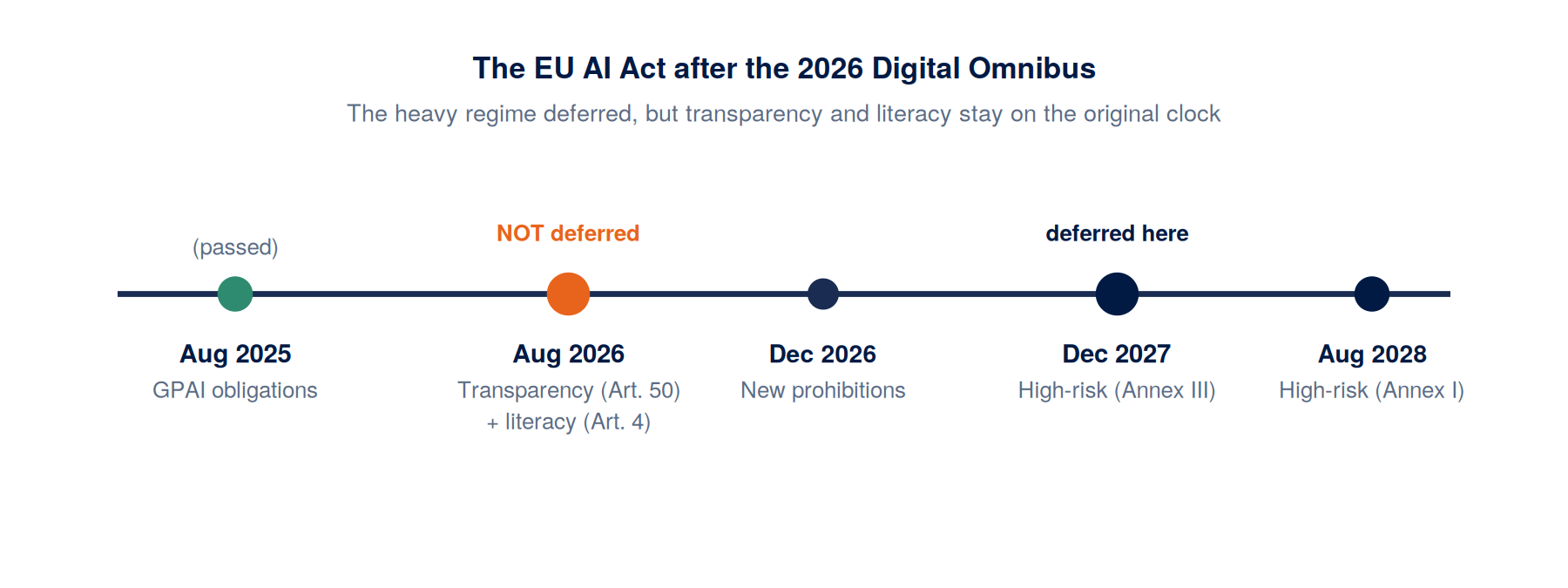
The strategic reading matters more than the dates. The delay is narrow and it is a deferral, not a dismantling. The Act's architecture is fully intact, transparency and literacy obligations are live in 2026 regardless, and the harmonized standards enterprises will ultimately be measured against are the ISO standards this article maps. The correct response to the deferral is not relief. It is to use the additional time to build durable governance machinery now, on the ISO and NIST foundation, so that high-risk conformity in 2027 becomes a formality rather than a scramble. Enterprises that read the deferral as permission to stop have misread it. The backstop is fixed, and the heaviest regime is still coming.
The reason these three instruments feel like competitors is that they all claim the words "AI governance." The reason they are not competitors is that they operate at three different altitudes, each answering a question the others do not.
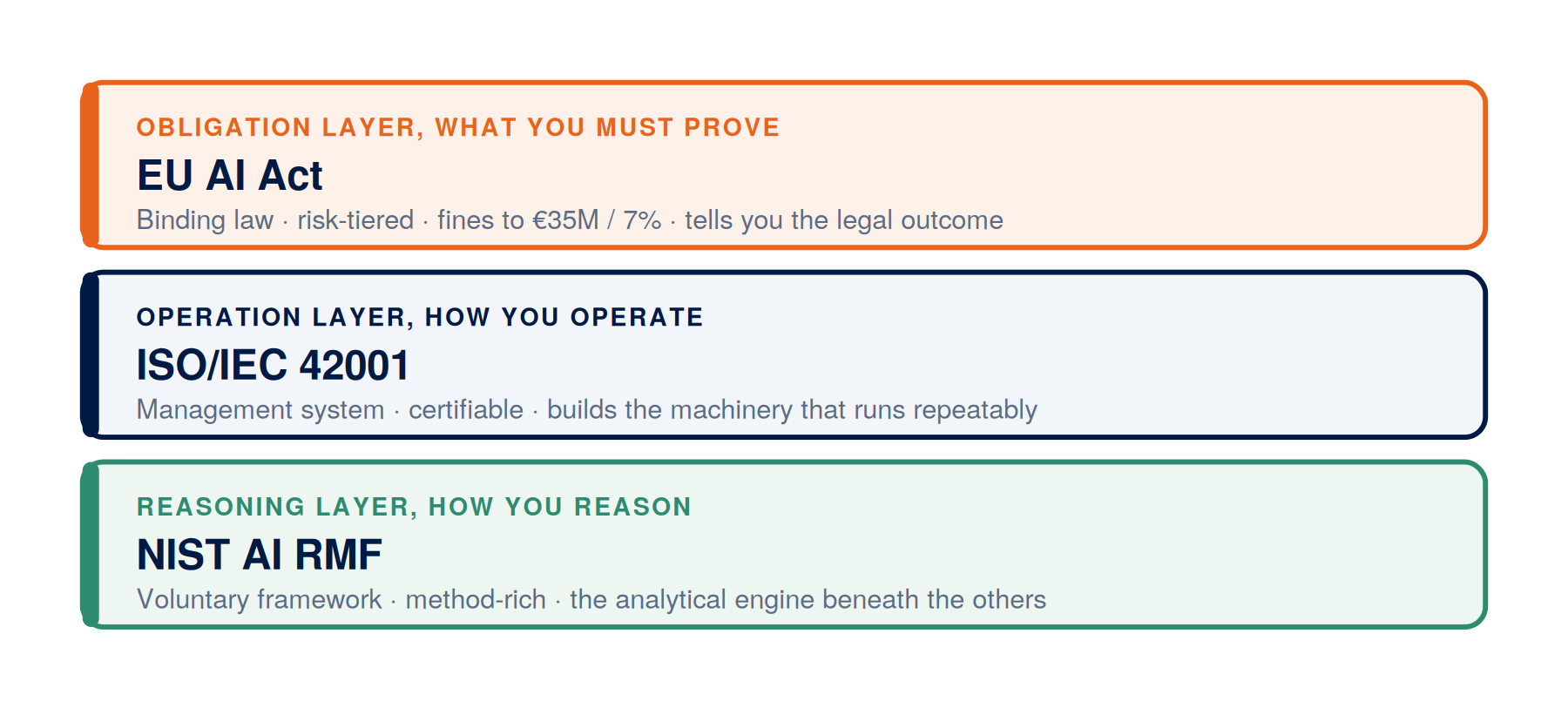
It is law. It tells you what you must achieve to place AI on the European market without penalty. It classifies systems into four risk tiers, unacceptable, high, limited, minimal, and attaches obligations to each, with a parallel track for general-purpose AI models. It is mandatory for any enterprise whose AI touches the EU market, regardless of where the enterprise sits, and it is increasingly a de facto global baseline because multinationals standardize on the strictest applicable regime. What it gives you is a compliance target. What it does not give you is a method for hitting it.
It is a management system standard, the first international standard for an AI Management System, published in December 2023 PUBLISHED. It tells you how to build the organizational machinery that produces responsible AI repeatably: the structure, roles, processes, and controls, run on a Plan-Do-Check-Act cycle. Its requirements sit in Clauses 4 through 10, context, leadership, planning, support, operation, performance evaluation, and improvement, and it carries a reference set of 38 controls, organized into nine groups, that an organization selects from based on its own risk assessment and documents in a Statement of Applicability. It is certifiable, which means an accredited body can audit you and issue third-party assurance. What it gives you is durable, auditable machinery. What it does not give you is the specific legal obligations or the deep technical test methods.
It is a voluntary framework PUBLISHED, published by the U.S. National Institute of Standards and Technology in January 2023, with a Generative AI Profile added in 2024. It tells you how to reason about AI risk through four functions that operate continuously, Govern, Map, Measure, and Manage. Govern cultivates the culture and accountability; Map establishes context and frames risk; Measure analyzes, tests, and benchmarks; Manage allocates resources to treat risk. It is technically rich, method-driven, and adapts to any sector or organization size. What it gives you is a rigorous way to think about risk. What it does not give you is the operational discipline of a management system or the enforceability of law.
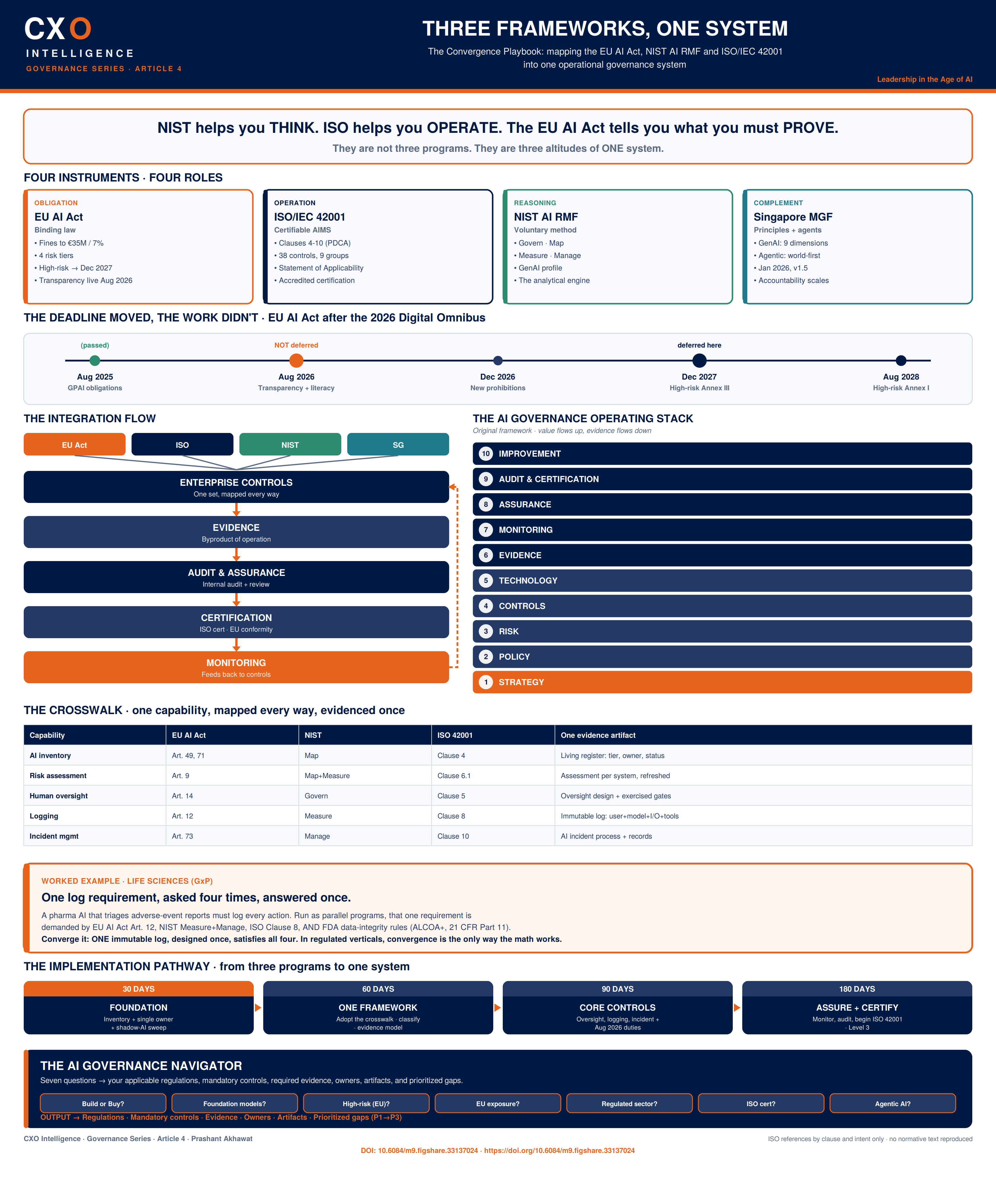
NIST helps you think. ISO helps you operate. The EU AI Act tells you what you are legally required to prove. One system needs all three.
The fastest way to understand why you need all three is to look honestly at the hole in each one. A framework's limitations are not a criticism; they are the reason the others exist.
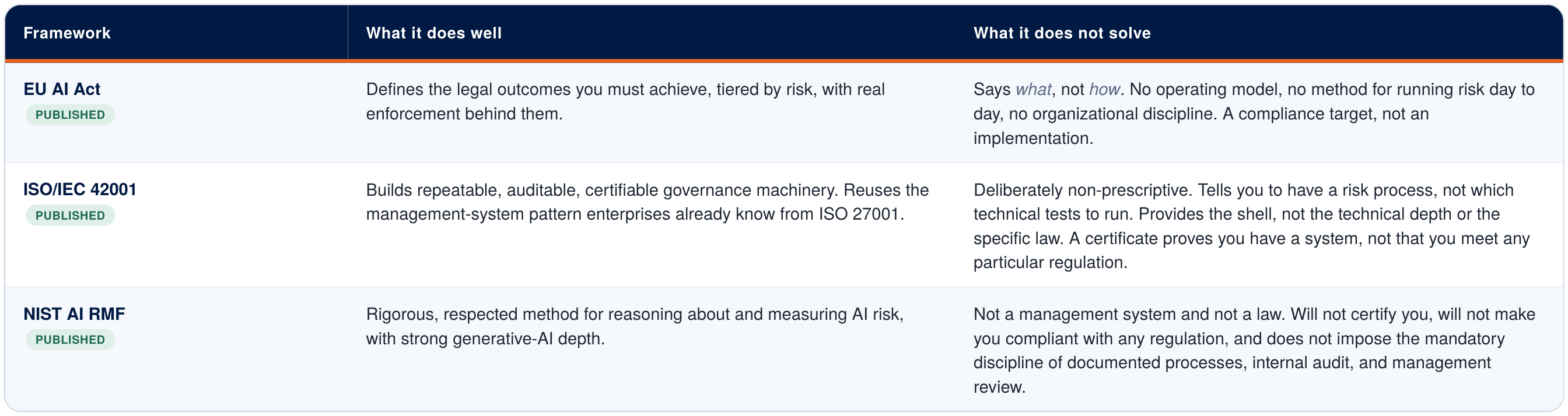
Read the right-hand column top to bottom and the logic of convergence writes itself. The EU AI Act needs a method and a machine; NIST is the method; ISO is the machine. ISO needs technical depth and legal grounding; NIST supplies the depth; the EU AI Act supplies the grounding. NIST needs operational discipline and enforceability; ISO supplies the discipline; the EU AI Act supplies the teeth. Each fills precisely the gap the others leave. That is not a coincidence, it is what makes them a stack rather than a set.
One reason enterprises under-use ISO in their convergence effort is that they treat 42001 as a single standard rather than the anchor of a family. The family matters, because the harmonized standards that will eventually underpin EU AI Act conformity are drawn from exactly this body of work, and because several of the companion standards fill specific gaps 42001 leaves open. All of the following are referenced here by number and intent only; consult the standards directly for their normative text.
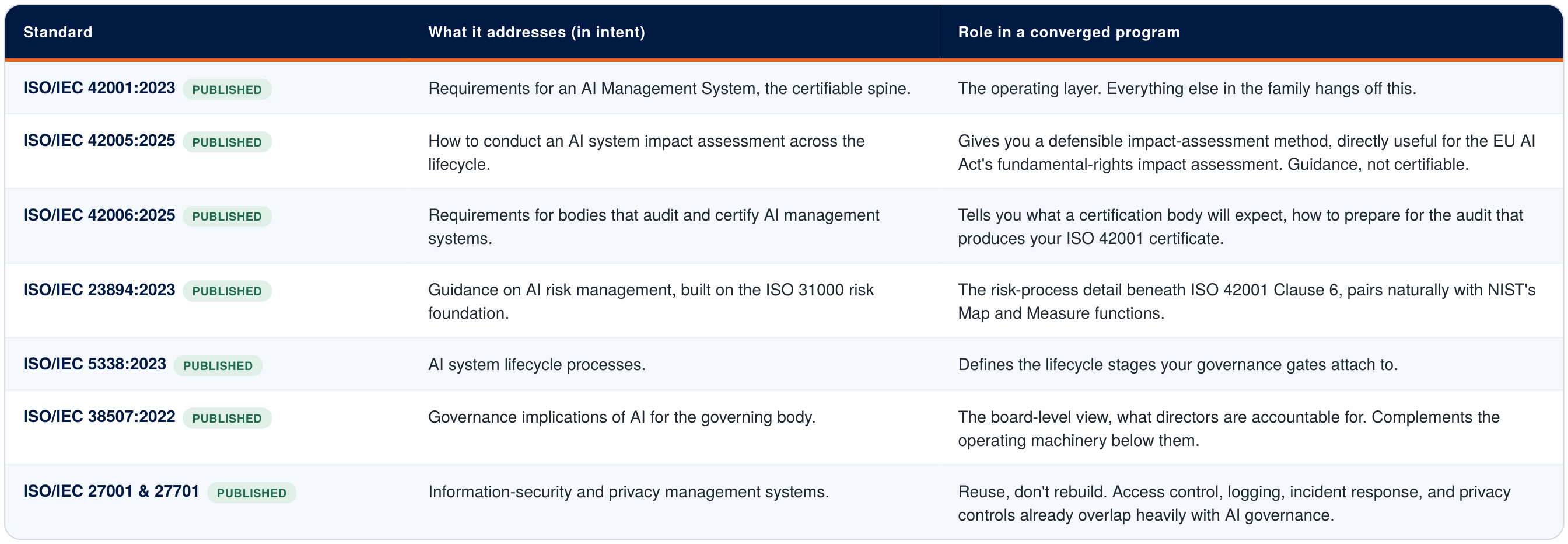
The practical consequence: an enterprise that already holds ISO 27001 is not starting its AI governance from zero. A large share of the controls, access management, logging, supplier management, incident response, already exist and can be extended rather than rebuilt. The convergence effort is as much about mapping what you already have as it is about building something new.
In Article 1 of this sub-series I introduced the AI Governance Convergence Model, the idea that the instruments converge rather than compete. That model answers why. This section answers how, by turning the model into an operating structure any enterprise can adopt.
The core insight is simple and, in my experience, the thing most programs get wrong: governance is a stack, not a checklist. Value flows up: each layer enables the one above it. Evidence flows down: each layer proves the intent of the one above. A weakness at any layer undermines everything above it, which is why programs that start at the control layer, skipping strategy and policy, produce controls nobody can trace to a purpose and evidence nobody can defend.
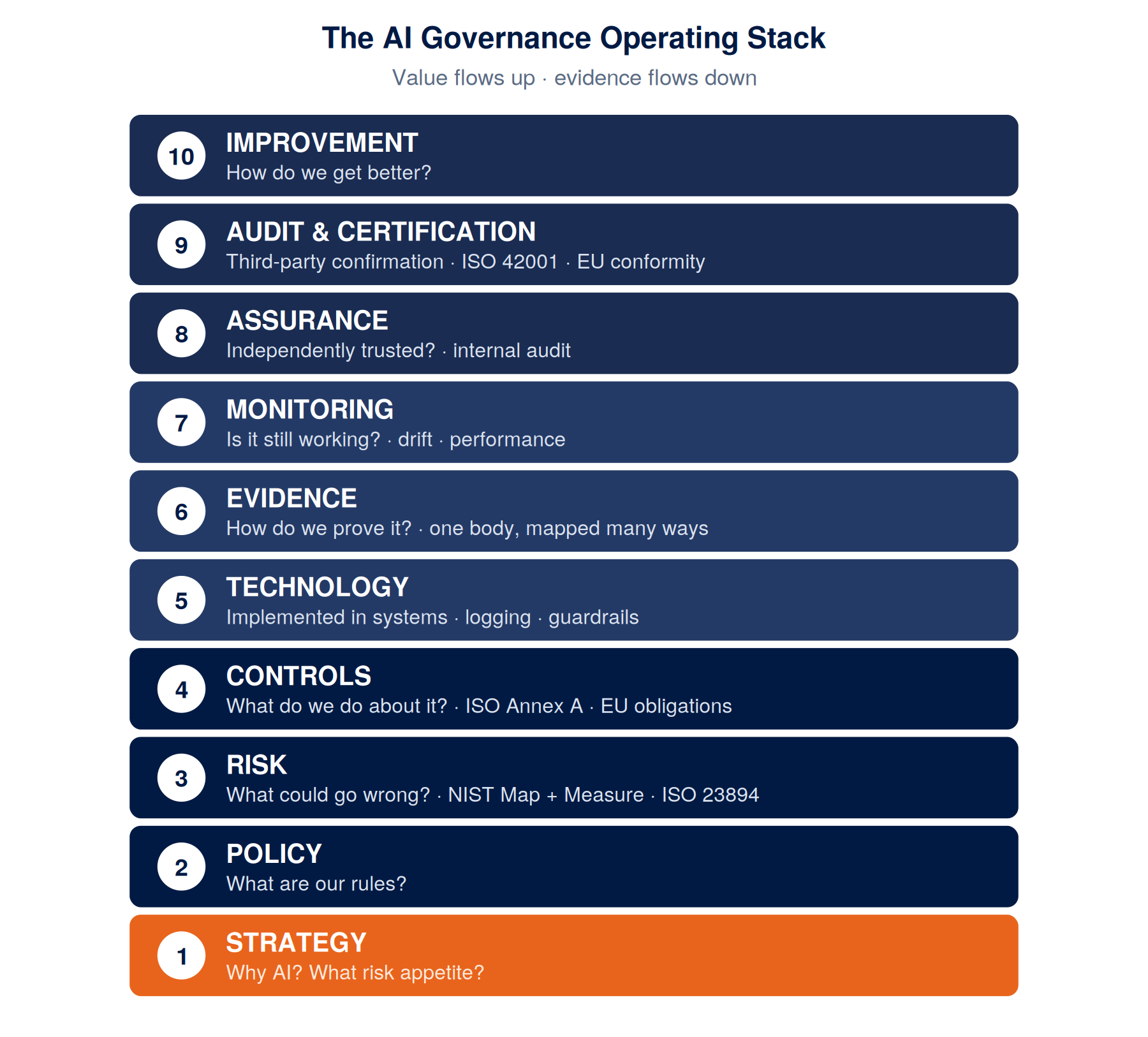
The stack runs from Strategy (why we use AI, and our risk appetite, owned by the board) up through Policy, Risk (where NIST's Map and Measure and ISO 23894 live), Controls (where ISO Annex A selection and EU obligations become concrete), Technology, Evidence (the layer most programs neglect and auditors care about most), Monitoring, Assurance, Audit & Certification (ISO 42001, EU conformity), and finally Improvement, which closes the loop back to Strategy.
What the stack does that a checklist cannot is give every stakeholder a shared map. The board engages at Layers 1 and 10. Engineers work at Layers 5 and 7. Auditors work at Layers 8 and 9. Everyone sees how their work connects to the whole, and every control traces down to a risk and up to a purpose. Adopt it, and the three frameworks stop being three programs, they become inputs to one operating system.
The stack is the structure. The crosswalk is the content that fills it: a map where each row is a governance capability the enterprise needs, and the columns show how each framework addresses it, what single piece of evidence satisfies all three, and who owns it. Build the evidence once; map it three ways.
The full crosswalk runs to more than thirty capabilities and is provided in the companion guidance document. What follows is a representative extract, enough to show the shape and to be immediately useful. ISO references cite clause numbers and Annex A control-group intent only; NIST references cite the four functions.
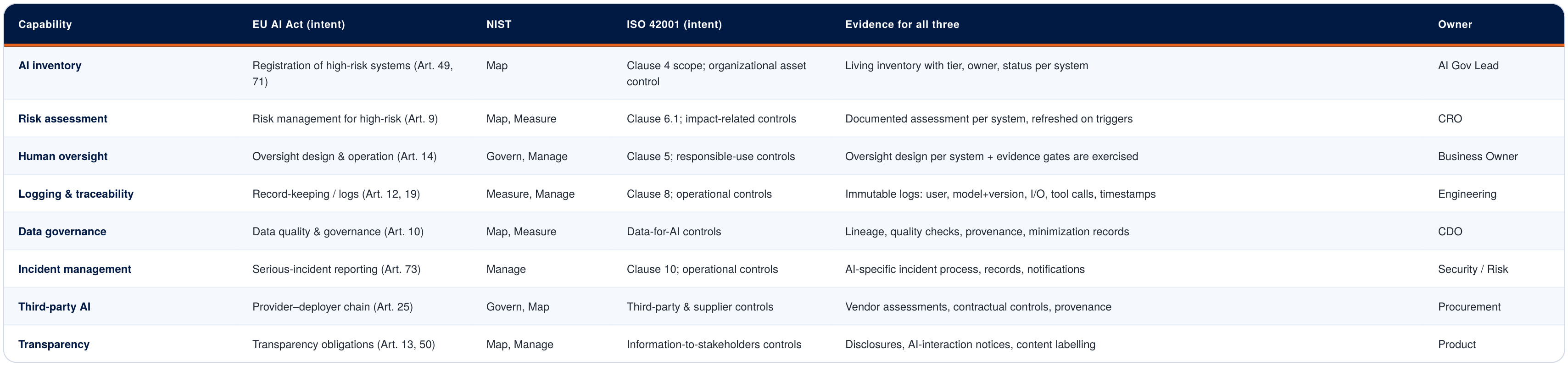
The discipline that makes this work is the evidence column. Written well, one artifact satisfies all three instruments, the immutable log that answers the EU AI Act's Article 12, NIST's Measure function, and ISO's operational-control clause is the same log. Most organizations produce three logs, or three descriptions of one log, because three teams asked for it separately. Converge the ask, and you converge the work.
Governance is not a gate at the end of a project; it is a property of every stage of the AI lifecycle, and all three frameworks agree on this even though they express it differently. Risk enters when data is chosen, when the model is built, when it is validated for a use, when it is deployed, and every day it runs in production. Control has to enter at each of those same points, and at each point, one activity can satisfy all three frameworks at once.
The stage enterprises consistently under-invest in is the last one. Monitoring is treated as an operational afterthought, when for AI it is the load-bearing wall of the entire governance structure. This is the same lesson the regulated verticals learned the hard way: a model that is watched, with thresholds and triggers and a documented response, is a governed model; a model that is deployed and forgotten is an incident with a delay on it. The EU AI Act calls this post-market monitoring, NIST calls it the Measure and Manage functions operating continuously, and ISO 42001 calls it Clause 9 performance evaluation. They are describing the same wall.
A model that is watched is a governed model. A model that is deployed and forgotten is an incident with a delay on it.
Convergence fails at the top as surely as at the seams. The board is accountable for AI risk, but most boards receive either nothing or an unreadable technical report, and when directors cannot see AI risk in terms they can act on, accountability breaks. A converged program translates all three frameworks into one small set of executive metrics: inventory coverage and high-risk assessment completeness (are we governing what we run?), open high-severity findings and AI incidents (what could hurt us?), compliance posture against the applicable regime and governance maturity level (where do we stand?), and resource adequacy (are we funded to close the gap?). Report the risk-facing indicators every board meeting and the performance indicators quarterly, on one page. The detail lives in the operating layers beneath; the board view is the translation. The companion guidance document provides a full board dashboard, KPIs, KRIs, and executive metrics, built for exactly this.
Convergence is easiest to understand when it is concrete, so consider the vertical this sub-series examined in depth in Article 2: a pharmaceutical company deploying AI into a GxP-regulated workflow, such as an AI system that triages adverse-event reports in pharmacovigilance. This is exactly where the abstract idea of "one system, not three programs" earns its keep, because in life sciences the frameworks do not merely overlap. They stack, and the cost of running them separately is measured in patient safety and regulatory liability, not just wasted effort.
Watch what happens to a single governance activity when you converge it. The company must log every consequential action the AI takes. Run as parallel programs, that one requirement gets asked four times: the EU AI Act wants record-keeping under Article 12; NIST wants it under the Measure and Manage functions; ISO 42001 wants it under its operational-control clause; and the FDA's own expectations, together with data-integrity rules such as ALCOA+ and 21 CFR Part 11, want a complete, attributable, reconstructable record of what the model saw, concluded, and did. Four teams, four log specifications, four audits of the same log. Converge it, and there is one immutable log, designed once, that answers all four at the same time. That is the whole thesis, rendered in a single control.
The same collapse happens across the board. The risk and impact assessment the EU AI Act requires for a high-risk system (a credit-scoring model, or a diagnostic aid) is the same assessment ISO Clause 6 and ISO/IEC 42005 describe, informed by the same NIST Map and Measure functions, and in life sciences it doubles as the FDA-style Context-of-Use and model-risk assessment. Human oversight is one design that satisfies the EU AI Act's Article 14, ISO's responsible-use controls, NIST's Govern function, and the GxP requirement for meaningful human review of AI output before it reaches a patient. The convergence is not a convenience. In a regulated vertical it is the only way the numbers work, because the alternative is a governance headcount that scales with the number of frameworks rather than the number of systems.
And the pattern generalizes. In financial services, the same convergence maps the EU AI Act onto model-risk-management expectations; in the public sector, onto administrative-law and transparency duties. The horizontal system is identical. Only the sector layer on top changes, which is precisely why building the convergence once, on the ISO and NIST foundation, pays off across every vertical an enterprise operates in. The life-sciences lesson is the universal lesson: govern the system, not the frameworks.
In a consumer app, ungoverned AI is a product risk. In a regulated workflow, it is the same risk assessed four times, or governed once. Convergence is how you choose the second.
Abstract principle becomes useful when it is specific. Here are the failure modes I see most often when enterprises attempt to converge their AI governance, what each looks like, and the mitigation that actually works. If your program exhibits any row in the middle column, you have found a place to begin.
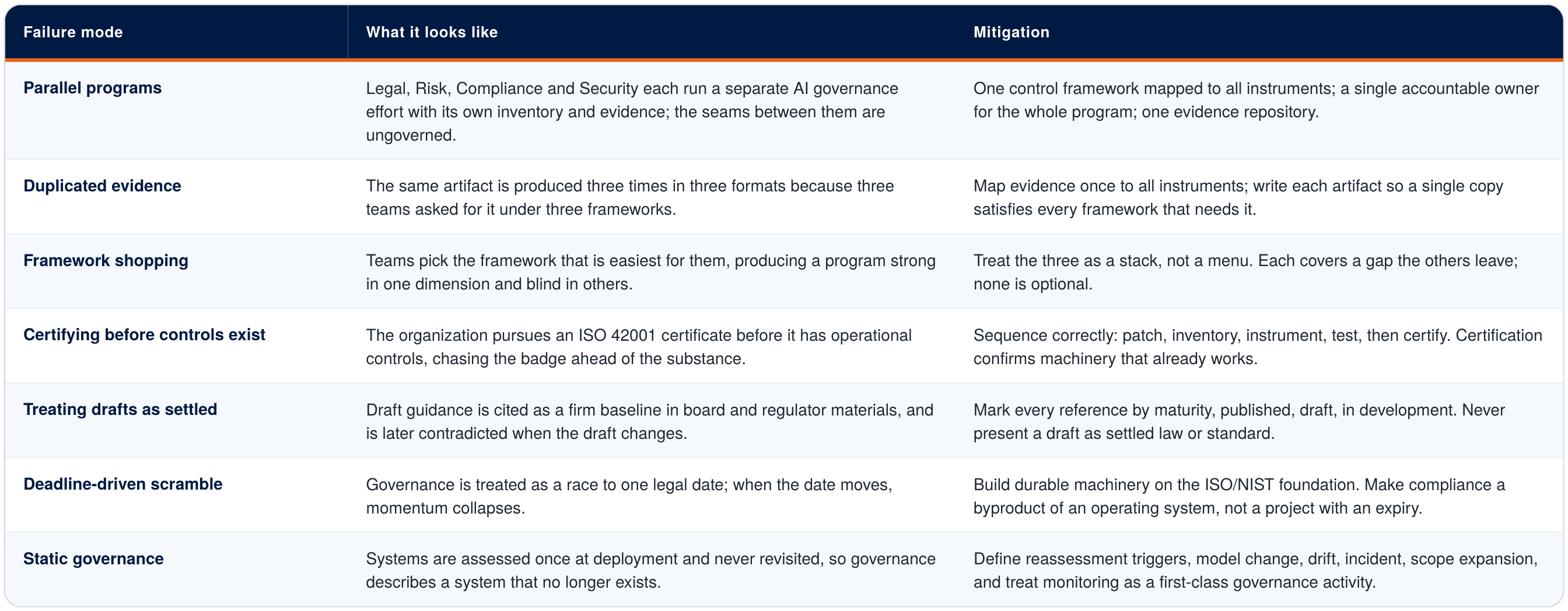
If it is not mapped, it is not converged. Running three good programs in parallel is not convergence; it is three programs. The whole value is in the single control set and the single body of evidence beneath it.
This is the part worth returning to. These are the questions that separate an organization genuinely running a converged governance program from one that merely believes it is. Some are strategic and belong to the CEO and the accountable AI owner; some are operational and belong to Risk, Engineering, and Compliance. All of them will eventually be asked, by a regulator, an auditor, a partner running diligence, or the internal review that follows an incident. It is far better to ask them of yourself first. A confident, evidenced "yes" is a sign of maturity. Every "no," "partly," or "we think so" is a specific, fundable place to begin.
Knowing that convergence is right does not tell you how to get there from wherever you are today, which for most enterprises is somewhere between "no coherent program" and "three disconnected ones." What follows is a pathway: a phased strategy that takes an organization from fragmentation to a single operating system, sequenced so each phase makes the next one possible. The ordering is not arbitrary. Skipping a phase produces fragile governance that fails under audit or incident, which is why the most common failure is trying to certify before the controls exist.
You cannot converge governance over systems you have not mapped, so the pathway begins with sight. Appoint a single accountable owner for the whole program, the AI governance lead most enterprises have not yet created, and give that role authority across functions. Stand up a cross-functional governance committee. Run an AI system discovery sweep, including shadow AI and vendor-embedded features, and build the first inventory with an owner assigned to each system. Determine, at the enterprise level, whether the EU AI Act applies to you at all. The exit test for this phase is simple: you can now answer "what AI do we run, and who owns it?"
This is the phase that eliminates the parallel programs. Adopt one control framework mapped to the EU AI Act, NIST, and the ISO family at once, the crosswalk, so that every governance activity is defined once and satisfies every instrument that needs it. Classify each inventoried system by EU AI Act risk tier and record the rationale. Stand up the risk register and the evidence repository, and establish the evidence model early, because evidence built into the process is durable and evidence retrofitted for an audit is fragile. Build the RACI with exactly one accountable owner per activity. Define the deployment approval gate. The exit test: every system is classified, the control framework is adopted, and nothing ships without passing the gate.
With the framework in place, implement the foundational controls, starting with high-risk systems. Run the risk and impact assessments. Implement human oversight that is genuine rather than a rubber stamp. Implement logging and traceability to the standard that reconstructs any action. Establish data governance and AI-specific incident response. Crucially, implement the Article 50 transparency and Article 4 AI-literacy obligations that are live from August 2026 regardless of the high-risk deferral. The exit test: high-risk systems have current assessments, operating oversight, adequate logging, and you meet your 2026-applicable EU obligations.
Now extend coverage and prove effectiveness. Implement monitoring and measurement across performance, drift, bias, and security, treating monitoring as the load-bearing wall it is. Conduct adversarial testing of high-risk and agentic systems. Complete vendor assessments. Stand up training. Conduct the first internal audit and deliver the first full board dashboard. Begin ISO 42001 certification now, and only now, because certification confirms machinery that already works. Prepare the conformity-assessment approach for high-risk systems ahead of the December 2027 deadline, not against it. The exit test: governance is comprehensive, monitored, independently assured, and positioned ahead of the deadline. This is Level 3 maturity, the point at which the program becomes genuinely defensible.
If the pathway feels large, concentrate on the five moves that unlock everything else, in order:
The organizations that walk this pathway will do something their competitors cannot: govern AI as a coherent capability rather than a collection of disconnected compliance efforts, spend a fraction of the effort, and produce stronger assurance. In a landscape where trust is increasingly the license to operate, that is not a compliance win. It is a strategic one.
Compliance is passing an inspection. Governance is being the kind of organization that would pass any inspection, because the machinery is real, the evidence is a byproduct of operation, and someone is genuinely accountable.
If your AI touches the EU market, the EU AI Act is mandatory, that one is not a choice. NIST and ISO are voluntary, but they solve problems the Act does not: NIST gives you a rigorous method for reasoning about risk, and ISO gives you the operational machinery and, optionally, a certificate that provides third-party assurance. Most enterprises benefit from all three because each fills a gap the others leave. You can adopt NIST and ISO even with no EU exposure, and many organizations do, as a strong governance baseline.
No. It is a voluntary, certifiable management system standard. It carries no legal force, and no regulation currently requires it. Its value is that it provides durable, auditable governance machinery and a certificate that signals responsible AI management to customers, partners, and regulators. Certification is a market and assurance decision, not a legal obligation.
The heaviest part did. Under the 2026 Digital Omnibus, adopted by the Council on 29 June 2026, high-risk obligations for stand-alone Annex III systems moved to 2 December 2027, and for AI embedded in regulated products (Annex I) to 2 August 2028. Crucially, the Article 50 transparency obligations and the Article 4 AI-literacy duty were not deferred, they apply from 2 August 2026. The Act's overall architecture is unchanged.
They contribute substantially but do not cover AI-specific risk on their own. ISO 27001 and SOC 2 address information security and controls, access management, logging, incident response, supplier management, which overlap heavily with AI governance and should be reused rather than rebuilt. But neither addresses AI-specific concerns such as model risk, bias, drift, explainability, or agentic autonomy. Extend them; do not rely on them alone. Note that SOC 2 produces a CPA opinion on control design or operating effectiveness, not a certification.
As a principle-level complement in the reasoning layer, alongside NIST, particularly valuable for enterprises with Asia-Pacific exposure and for agentic AI, where its January 2026 framework is the world's first built specifically for autonomous agents. It is voluntary and non-certifiable, so it enriches how you reason about risk rather than adding a separate compliance burden. I covered it in depth in Article 3 of this sub-series, "Strengthening the World's First Agentic AI Governance Framework."
Running the frameworks as parallel programs, separate inventories, separate risk assessments, separate evidence, owned by separate teams. It multiplies effort while leaving ungoverned seams between the teams, and it produces fragmented answers when a regulator or the board asks a single question. The fix is one control framework mapped to all instruments, one evidence repository, and one accountable owner.
Through a crosswalk: a capability-by-capability map where each row is a governance capability and the columns show how the EU AI Act, NIST, and ISO each address it, plus the single piece of evidence that satisfies all three. NIST's Map and Measure functions run the risk and impact assessments that ISO Clause 6 requires, operated through an ISO-structured management system, configured to produce exactly the evidence the EU AI Act's high-risk regime demands. One set of activities, one body of evidence, three frameworks satisfied.
Certification is worth pursuing once operational controls already exist, it confirms machinery that works, and it prepares you for the harmonized-standards regime the EU AI Act will ultimately rely on. The sequencing rule holds regardless of the deadline: patch the biggest gaps, build the inventory, instrument logging and monitoring, test, and then certify. Chasing the certificate before the controls exist produces a badge without substance, which fails under audit or incident.
Agentic systems act rather than merely predict, which raises the bar across every framework at once. Human oversight shifts from reviewing each output to setting boundaries and intervening on exceptions; attribution requires that every autonomous action be logged and reconstructable; and least-privilege scoping, containment, and kill-switch controls become essential. The EU AI Act's human-oversight and robustness requirements, NIST's Govern and Manage functions, and ISO's responsible-use controls all apply, and Singapore's agentic framework offers the clearest current guidance on the specifics.
It is the operational form of the AI Governance Convergence Model, a ten-layer structure running from Strategy at the base through Policy, Risk, Controls, Technology, Evidence, Monitoring, Assurance, Audit & Certification, and Improvement at the top. Value flows up (each layer enables the next) and evidence flows down (each layer proves the one above). It gives every stakeholder a shared map and ensures every control traces down to a risk and up to a purpose, turning three frameworks into inputs to one operating system.
A realistic path reaches a defensible operating state, a complete inventory, classified systems, core controls on high-risk systems, and a functioning evidence model, inside roughly six months, with a 90-day minimum-viable variant for smaller organizations. Progress is measured against a five-level maturity model, from ad hoc (Level 1) through systematic and evidence-generating (Level 3, the realistic near-term target and the point at which the program becomes genuinely defensible) to measured and optimized (Levels 4–5). The companion guidance document provides both the phased 30/60/90/180-day roadmap and the full maturity model with assessment criteria per level.
Article 1, You Can Outsource the Model. You Can't Outsource the Liability. Why AI governance is becoming the license to operate, with the liability precedents and the AI Governance Convergence Model.
Article 2, When AI Meets GxP. Governing AI in FDA and EMA regulated life sciences, and the end of one-time validation.
Article 3, Strengthening the World's First Agentic AI Governance Framework: Nine Recommendations for Singapore. A deep read of Singapore's Model AI Governance Framework for Agentic AI, with nine recommendations to strengthen it.
Article 4, Three Frameworks, One System. This article: the convergence playbook that maps the EU AI Act, NIST AI RMF and the ISO/IEC 42001 family into one operational system, the horizontal reference the vertical articles point back to.
Subscribe to the CXO Intelligence Series on LinkedIn →
All Articles in the Series: https://akhawat.com/writing
Chief Technology & AI Officer, Ninestars · Author of the AI-SAFE framework. Prashant Akhawat is a technology and AI leader with over 25 years building and scaling enterprise platforms, and the author of the AI-SAFE framework (the AI Substrate Architecture Framework for Enterprises). As Chief Technology & AI Officer at Ninestars, he has taken AI from experimentation to governed, production-scale capability across more than 50 regulated enterprises. An AWS Summit keynote speaker (Bengaluru 2026, Mumbai 2025) and alumnus of BITS Pilani and IMI Delhi, he writes the CXO Intelligence Series and is completing a book on the substrate shift, why AI stops being a tool and becomes the ground the enterprise is built on.
Follow Prashant Akhawat on LinkedIn →
Subscribe to the CXO Intelligence Series →
All Articles in the Series: https://akhawat.com/writing