The HOW layer · the working framework

AI‑SAFE V1.0 — the framework for treating AI as enterprise substrate, not a tool.

A tool is something you pick up for a task and put down afterward. Substrate is the material the whole structure rests on — it shapes what can be built, how work flows, and where risk concentrates. When AI becomes substrate, the questions stop being "which tool?" and start being "what is the architecture?"

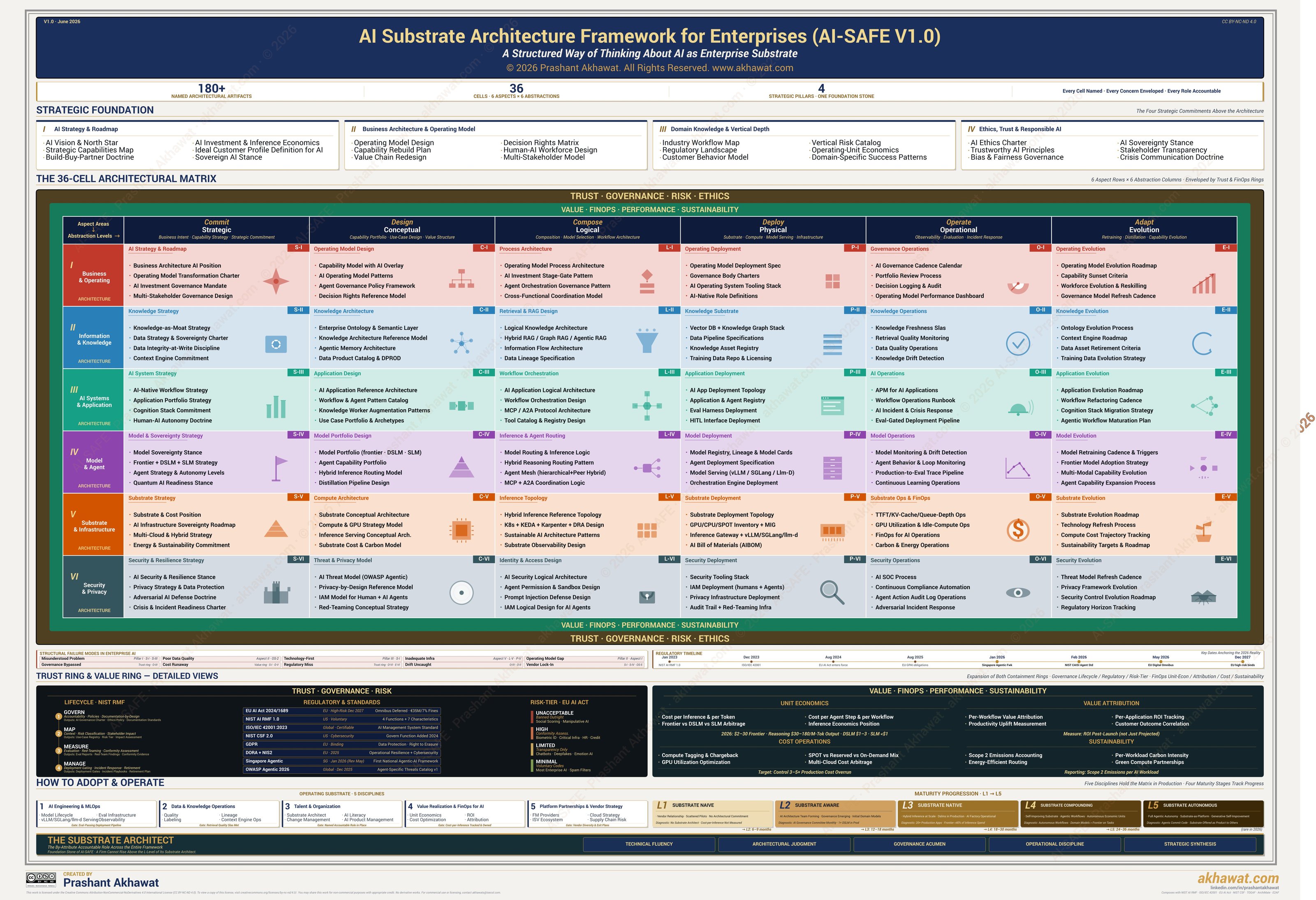
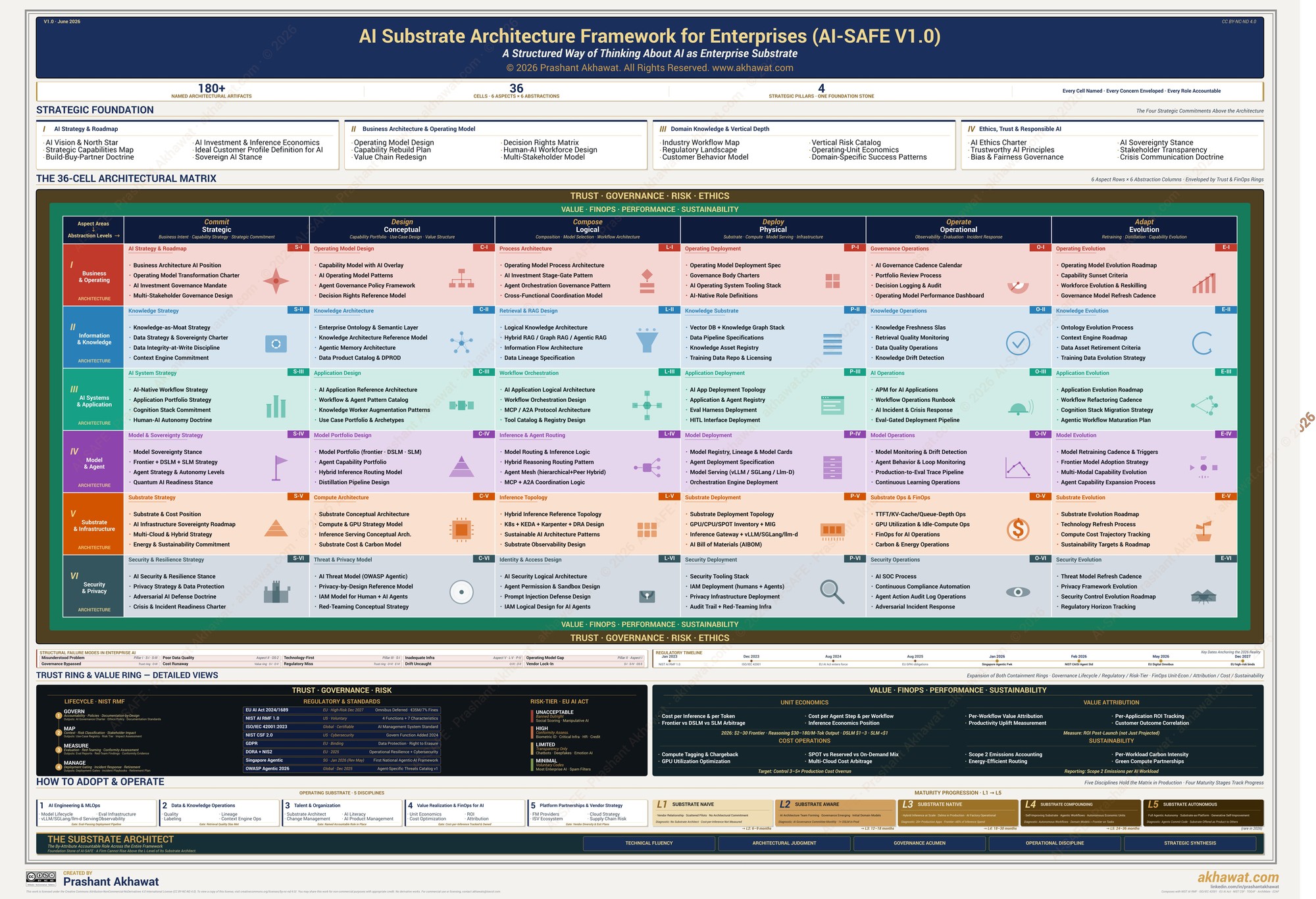
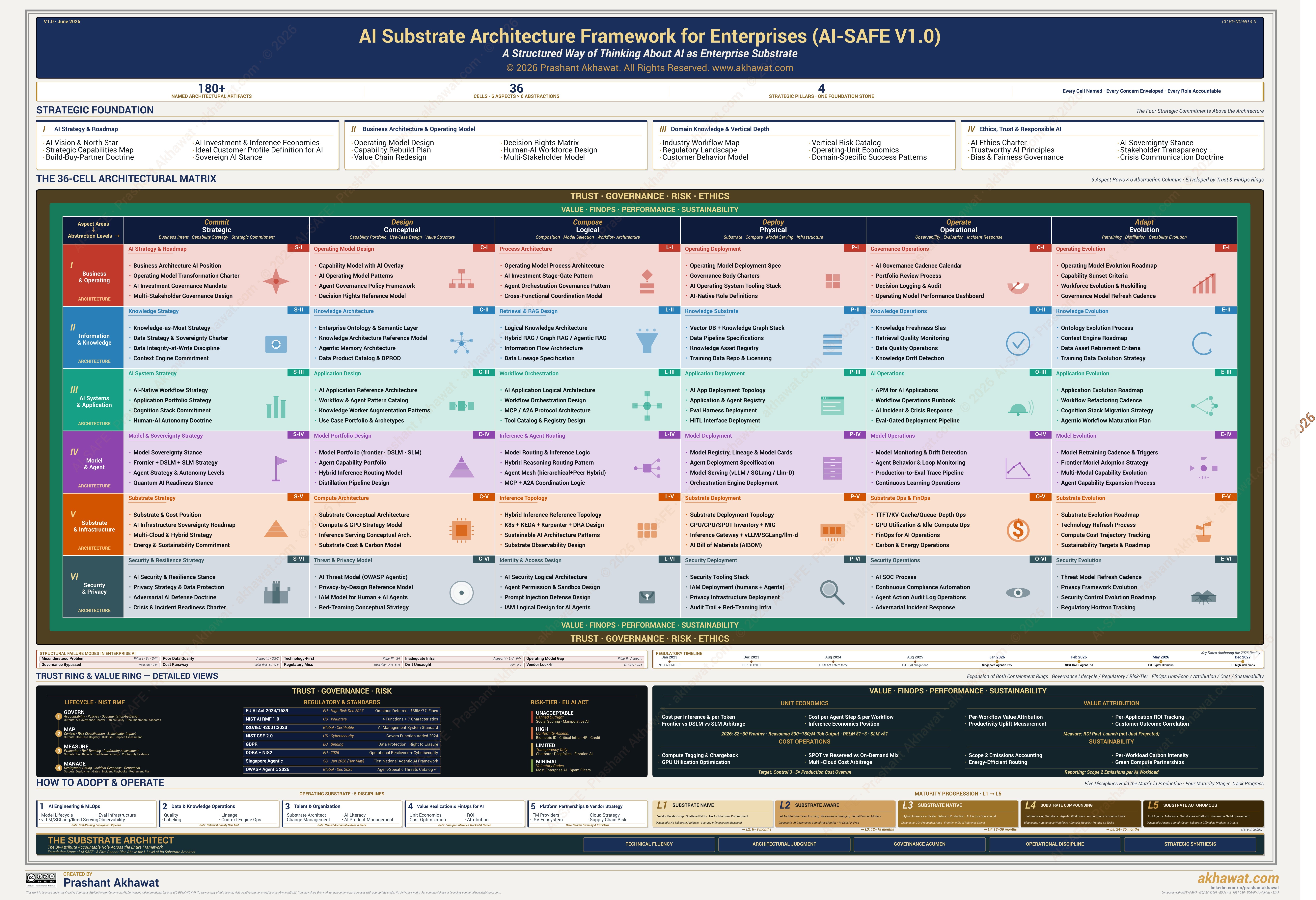
AI‑SAFE answers that by giving every concern a named place. Six aspect areas run from business and operating model down through information, applications, models, infrastructure, and security. Six abstraction levels run from strategic commitment across to operational evolution. Their intersection is a thirty‑six‑cell matrix where every cell is named and every role is accountable.

AI‑SAFE is the HOW of a three‑layer thesis: the book is the why — the substrate shift; the Cognition Stack is the what — the model; and this framework is the how — the artifact a working architect would tape to a wall.

Strategic foundation

Four commitments above the architecture

The pillars are decided before any cell is built. They are the strategic intent the matrix then executes.

I

AI Strategy & Roadmap

Where the firm decides what AI is for. The vision and north star set direction; the capabilities map and build-buy-partner doctrine decide how to get there; inference economics and the sovereign stance keep ambition tethered to cost and control.

  • AI Vision & North Star
  • Strategic Capabilities Map
  • Build‑Buy‑Partner Doctrine
  • AI Investment & Inference Economics
  • Ideal Customer Profile for AI
  • Sovereign AI Stance
II

Business Architecture & Operating Model

How the enterprise reshapes itself around AI. This pillar redesigns the operating model, the value chain, and the workforce — and fixes decision rights so it is clear what a human owns and what an agent may decide.

  • Operating Model Design
  • Capability Rebuild Plan
  • Value Chain Redesign
  • Decision Rights Matrix
  • Human‑AI Workforce Design
  • Multi‑Stakeholder Model
III

Domain Knowledge & Vertical Depth

The vertical expertise that makes AI useful rather than generic. Industry workflows, the regulatory landscape, customer behavior, and unit economics are what turn a capable model into a capability that wins in a specific market.

  • Industry Workflow Map
  • Regulatory Landscape
  • Customer Behavior Model
  • Vertical Risk Catalog
  • Operating‑Unit Economics
  • Domain‑Specific Success Patterns
IV

Ethics, Trust & Responsible AI

The commitments that keep the firm trustworthy as AI scales. An ethics charter and fairness governance set the floor; sovereignty, transparency, and a crisis-communication doctrine prepare the firm for the moments when trust is tested.

  • AI Ethics Charter
  • Trustworthy AI Principles
  • Bias & Fairness Governance
  • AI Sovereignty Stance
  • Stakeholder Transparency
  • Crisis Communication Doctrine

The 36‑cell architectural matrix

Six aspects, six abstractions, every cell named

Rows are aspect areas — what part of the firm. Columns are abstraction levels — how far from intent to operation. Select any cell to read a full description of what it is, why it matters, and what good looks like.

How to read a row

Each aspect area is one concern of the AI-native firm — from the business and operating model down through knowledge, applications, models, infrastructure, and security. Read a row left-to-right to follow a single concern from strategic intent all the way to its ongoing evolution.

How to read a column

Each abstraction level is a stage of maturity for every concern at once. Commit sets intent, Design shapes the concept, Compose works out the logic, Deploy puts it in production, Operate runs it, and Adapt evolves it. Read a column top-to-bottom to see what the whole firm must do at that stage.

How to use a cell

A cell is a place to stand. Find the concern (row) and the stage (column), and the cell tells you the named artifacts a working architect should be able to point to. Missing artifacts are the gaps; that is how the matrix doubles as a diagnostic.

Trust Ring · Governance · Risk · Ethics Value Ring · FinOps · Performance · Sustainability

Select a cell above to see its named artifacts.

The containment rings

Two disciplines wrap every cell

No cell stands alone. The Trust Ring governs how it behaves; the Value Ring proves it is worth running.

Trust Ring

Governance · Risk · Ethics

A lifecycle aligned to the NIST AI RMF — govern, map, measure, manage — mapped against the regulatory frontier and a risk‑tier classification.

Lifecycle · NIST RMF

  • Govern — policies, documentation
  • Map — risk classification
  • Measure — evaluation, red‑teaming
  • Manage — deployment gating, retirement

Standards & risk tier

  • EU AI Act 2024/1689
  • NIST AI RMF 1.0 · ISO/IEC 42001:2023
  • GDPR · DORA + NIS2
  • OWASP Agentic 2026

Value Ring

FinOps · Performance · Sustainability

Unit economics, cost operations, value attribution, and sustainability — the proof that a cell earns its compute rather than merely consuming it.

Unit economics & cost

  • Cost per inference & per token
  • Frontier vs DSLM vs SLM arbitrage
  • Compute tagging & chargeback
  • Target: control 3–5× production cost overrun

Value & sustainability

  • Per‑workflow value attribution
  • Per‑application ROI tracking
  • Scope 2 emissions accounting
  • Green compute partnerships

Maturity progression

From substrate‑naive to substrate‑autonomous

Five stages track how deeply AI has become substrate. Each gate has a diagnostic; most enterprises in 2026 sit between L1 and L2.

  1. L1

    Substrate Naive

    Vendor relationship. Scattered pilots, no architectural investment.

    Cost‑per‑inference not measured
  2. L2

    Substrate Aware

    AI architecture team forming. Governance emerging, initial domain models.

    First DSLM in production · 6–9 months
  3. L3

    Substrate Native

    Hybrid inference at scale. Domains in production, AI‑factory operational.

    25+ production apps · 12–18 months
  4. L4

    Substrate Compounding

    Self‑improving substrate. Agentic workflows, autonomous economic units.

    Autonomous workflows · 18–30 months
  5. L5

    Substrate Autonomous

    Full agentic autonomy. Substrate‑as‑platform, generative self‑improvement.

    Rare in 2026 · 24–36 months

Five disciplines hold the matrix in production

1

AI Engineering & MLOps

Model lifecycle, eval infrastructure, observability.

2

Data & Knowledge Operations

Quality, lineage, labeling, context‑engine ops.

3

Talent & Organization

Substrate architect, AI literacy, change management.

4

Value Realization & FinOps

Unit economics, cost optimization, ROI, attribution.

5

Platform Partnerships & Vendor Strategy

FM providers, ISV ecosystem, supply‑chain risk.

The poster

Download AI‑SAFE V1.0

The complete framework on one sheet. Click the poster to open the zoom viewer, or download a format below.

Licensed under Creative Commons Attribution‑NonCommercial‑NoDerivatives 4.0 International (CC BY‑NC‑ND 4.0). Share with attribution; no commercial use or derivative works. For commercial use or licensing, contact the author.