 Prashant AkhawatBuilding AI-Native Enterprises
Prashant AkhawatBuilding AI-Native Enterprises
Prashant AkhawatBuilding AI-Native Enterprises
Companion Reference to Article 4, Three Frameworks, One System. ISSN: applied for.
A CXO Intelligence: Governance Series Companion Reference Companion Reference to Article 4 of the CXO Intelligence: Governance Series, "Three Frameworks, One System: The Convergence Playbook for AI Governance" Leadership in the Age of AI
Cite as: Akhawat, P. (2026). The Enterprise AI Governance Crosswalk: Mapping the EU AI Act, NIST AI RMF and the ISO/IEC 42001 Family into One Operational System (CXO Intelligence: Governance Series, Companion Reference to Article 4). akhawat.com
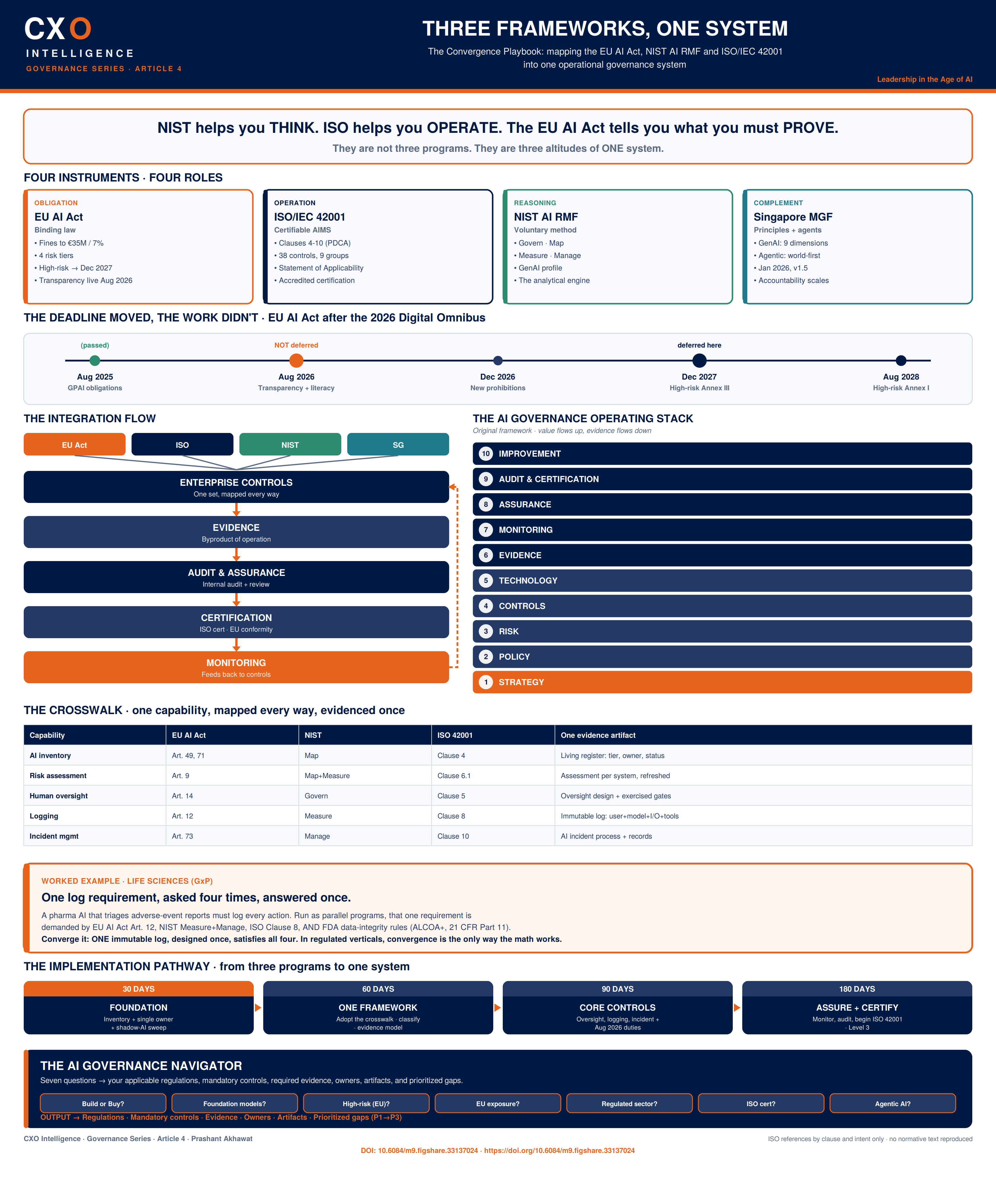
The companion executive poster is published alongside this reference.
This guide is a practical implementation reference. It does not reproduce the text of any standard. All clause and article references are pointers; consult the source documents for normative wording. Regulatory timelines and standard statuses reflect mid-2026 and should be re-verified before formal use, this field is moving quickly, and one central date changed materially in the months before publication.
Every enterprise deploying AI now faces the same structural problem: three major governance instruments have arrived at once, they overlap heavily, they use different vocabularies, and none of them alone is sufficient. Organizations respond by running three parallel programs, a legal team reading the EU AI Act, a risk team adopting the NIST AI Risk Management Framework, and a compliance team pursuing ISO/IEC 42001 certification, that duplicate effort, generate conflicting artifacts, and still leave gaps.
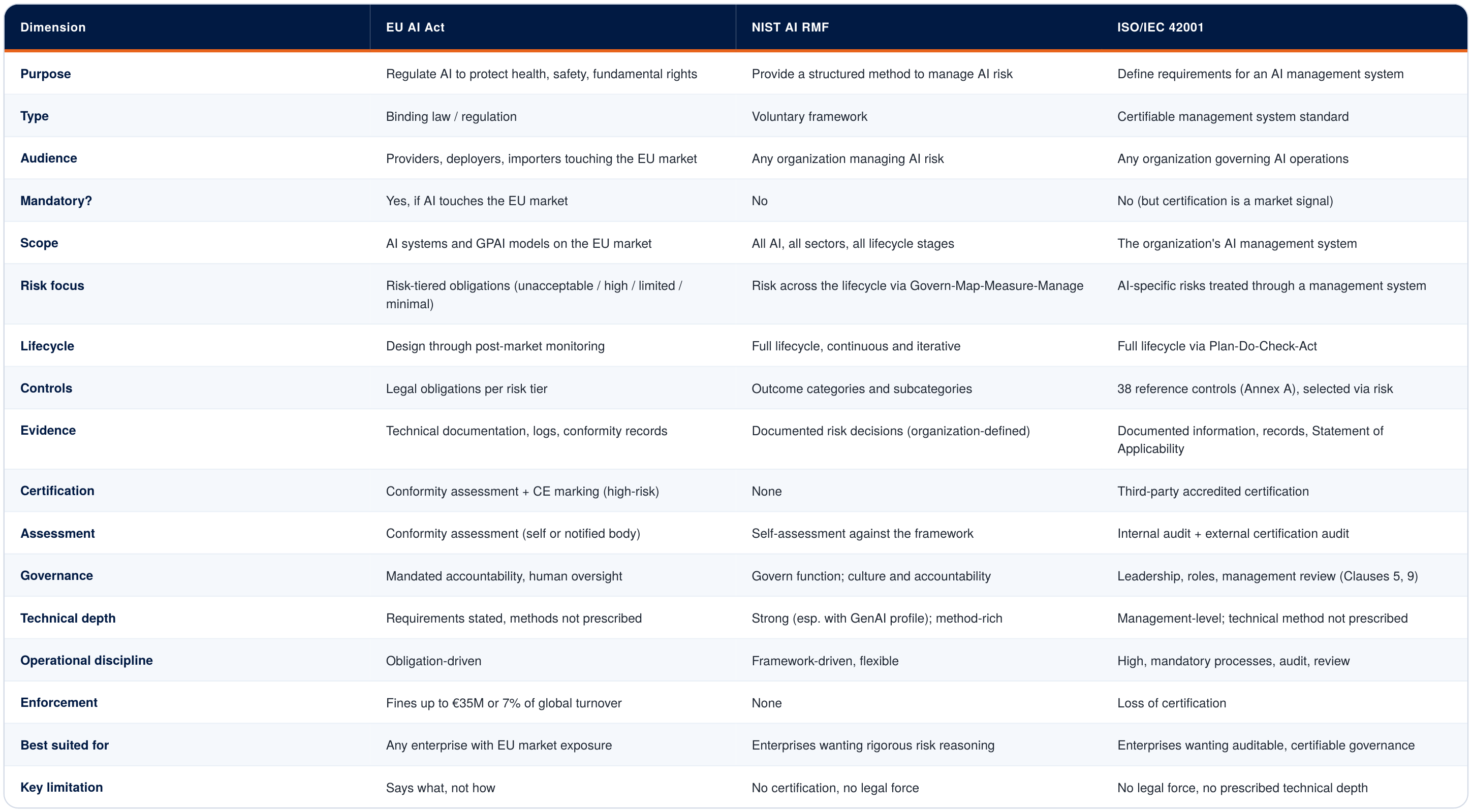
This is a waste, and it is avoidable. The three instruments are not competitors. They are three views of the same underlying reality, pitched at three different altitudes:
Put plainly: NIST helps you think, ISO helps you operate, and the EU AI Act tells you what you are legally required to prove. An enterprise that treats them as one integrated stack, a single set of controls generating a single body of evidence, mapped once to all three, spends a fraction of the effort and ends up with a stronger governance posture than one running three disconnected programs.
That integration is the purpose of this guide. The core deliverable is the Crosswalk Matrix in Part 5: a single table where each row is a governance capability your enterprise needs, and the columns show how each instrument addresses it, what evidence satisfies all three at once, who owns it, and how to prioritize it. Around that matrix, this guide provides an operating model, a maturity model, a phased roadmap, a board dashboard, an original operating-stack framework, and a decision tool, the AI Governance Navigator, that tells any given enterprise which obligations actually apply to it.
One timing note that reframes everything for European deployment. As this guide went to press, the EU formally simplified the AI Act's timeline. The heaviest high-risk obligations, originally due 2 August 2026, were deferred. This does not reduce the work; it changes its sequencing, and it makes the case for building on the durable ISO and NIST machinery now, rather than racing a legal deadline, stronger than ever. Article 4, the companion article to this guide, covers this in detail.
The enterprises that win the next two years will not be those that comply fastest with one instrument. They will be those that build governance machinery once, generate evidence once, and satisfy all three, and every instrument that follows, from the same operational foundation.
Most AI governance programs underperform for reasons that have little to do with the technology and everything to do with operating design. Six failure patterns recur across enterprises of every size and sector.
The most common and most expensive mistake. Legal owns the EU AI Act, risk owns NIST, compliance owns ISO, and security owns the technical controls, and none of them share a data model. The same AI system is inventoried four times in four formats. The same risk is assessed under four methodologies. When an auditor, a regulator, or the board asks a question, four teams produce four partial, inconsistent answers. The fix is not more coordination meetings; it is a single control framework that maps to all instruments at once, which is what Part 5 provides.
Enterprises write AI policies and then discover nobody owns their enforcement. A policy that says "high-risk AI must undergo human oversight review" is worthless if no named role is accountable for running that review, no artifact records it, and no trigger initiates it. Governance fails at the seam between policy and operation, the layer where a written commitment becomes a named owner, a defined trigger, a produced artifact, and a retained piece of evidence. Most programs have the policy layer and the technology layer, and nothing connecting them. Part 9 (Operating Model) and Part 13 (the Operating Stack) exist to fill this seam.
You cannot govern what you have not inventoried, and most enterprises do not know how many AI systems they run. Shadow AI, models embedded in SaaS tools, personal-account usage, agents spun up by individual teams, third-party features that quietly became AI, means the real inventory is always larger than the official one. Every downstream governance activity (risk assessment, classification, monitoring, evidence) depends on an inventory that is complete and living. This is the single most common root cause of governance failure, and it is why every roadmap in this guide starts there.
A governance program that produces binders rather than behavior change is theatre. The test of a control is not whether a document exists but whether the document is generated as a byproduct of an actual operational activity, is current, has an owner, and could be produced on demand under audit. Evidence built as an after-the-fact compliance exercise is fragile, stale, and unconvincing. Evidence built into the operating process is durable. This distinction, between documentation and operational evidence, runs through the entire guide.
AI systems are not static software. Models drift, are retrained, are swapped for newer versions, and change behavior as their inputs change. A governance program that assesses a system once at deployment and never revisits it is governing a system that no longer exists. Effective governance is continuous: it defines triggers for reassessment (model change, scope expansion, performance degradation, incident) and treats monitoring as a first-class governance activity, not an operational afterthought.
The board is accountable for AI risk, but most boards receive either nothing or an unreadable technical report. When the board cannot see AI risk in terms it can act on, exposure, incidents, compliance posture, resource adequacy, it cannot govern, and accountability breaks. A functioning program translates operational governance into a small set of executive metrics the board actually uses. Part 7 (Board Dashboard) addresses this directly.
The through-line: every one of these failures is an operating-model failure, not a knowledge failure. Enterprises do not struggle because they lack access to the standards. They struggle because they have not converted the standards into an operating system, owners, triggers, artifacts, evidence, and a rhythm of review. The rest of this guide is that conversion.
To integrate the three instruments, you first have to understand precisely what each one is, what it does well, and, critically, what it does not solve. Confusion between them is the source of most wasted effort.
What it is. The world's first comprehensive horizontal AI regulation (Regulation (EU) 2024/1689). It entered into force on 1 August 2024 and applies to any organization placing AI systems on the EU market or whose AI output is used in the EU, regardless of where the organization is based. It is binding law, enforced by national competent authorities and, for general-purpose AI models, the European AI Office.
How it works. The Act classifies AI systems into four risk tiers and attaches obligations to each:
General-purpose AI (GPAI) models sit on a parallel track with their own transparency, documentation, and, for models presenting systemic risk, additional obligations.
The timeline, and the change that matters. The Act phases in over several years. Two milestones have passed: prohibitions (February 2025) and GPAI obligations (August 2025). The pivotal milestone for most enterprises was the high-risk regime, originally set for 2 August 2026.
That date moved. Through 2025 the implementation was visibly off track, national authorities were not designated in time and the harmonized standards providers need to demonstrate conformity were not ready. In response, the EU brought forward a simplification package (the "Digital Omnibus"). A political agreement was reached on 7 May 2026, and the Council gave final approval on 29 June 2026. Under the adopted package:
The strategic reading: the delay is real but narrow, and it is a deferral, not a dismantling. The Act's architecture, risk tiers, conformity assessment, the GPAI track, the AI Office's authority, is fully intact. Transparency and literacy obligations are live in 2026 regardless. And the extra time should be spent building the durable governance machinery (via ISO and NIST) that makes high-risk compliance a byproduct rather than a scramble. Enterprises that treat the deferral as permission to stop have misread it; the backstop is fixed, the heaviest regime is coming, and the work is substantial.
Who should implement it. Mandatory for any enterprise with AI touching the EU market. Even outside the EU, it is becoming a de facto baseline because global enterprises standardize on the strictest applicable regime.
What it does NOT solve. The Act tells you what legal outcomes you must achieve, not how to build the organization that achieves them. It specifies obligations, not operating models. It does not tell you how to structure accountability, how to run a risk process day to day, or how to build repeatable machinery. It is a compliance target, not an implementation method, which is exactly the gap ISO and NIST fill.
What it is. The first international management system standard for artificial intelligence, published in December 2023. It defines requirements for an AI Management System (AIMS), the organizational structure, policies, processes, and controls through which an enterprise governs AI responsibly and repeatably. It is certifiable: an accredited body can audit an organization and issue a certificate, providing third-party assurance.
How it works. Like all modern ISO management standards, 42001 follows the common "Annex SL" high-level structure and runs on a Plan-Do-Check-Act cycle. Its requirements sit in Clauses 4 through 10:
Alongside the clauses, Annex A provides a reference set of 38 controls organized into 9 groups, spanning AI policy, internal organization, resourcing, AI impact assessment, the AI system lifecycle, data for AI, information provided to stakeholders, responsible use of AI, and third-party and supplier relationships. Crucially, these controls are not applied wholesale: an organization performs its risk assessment, then selects applicable controls and documents its choices, inclusions and exclusions with justifications, in a Statement of Applicability (SoA). The controls are deliberately high-level and principle-based rather than prescriptive technical steps, and Annex B offers informative implementation guidance that auditors nonetheless reference.
Who should implement it. Any enterprise that wants durable, auditable AI governance machinery and, optionally, a certificate that signals it to customers, regulators, and partners. It is especially valuable where AI is central to the product or where third-party assurance carries commercial weight. Because it reuses the management-system pattern of ISO 27001, organizations with an existing ISMS can extend rather than rebuild.
What it does NOT solve. ISO 42001 is deliberately non-prescriptive. It tells you to have a risk process, but not which specific technical tests to run. It tells you to manage the lifecycle, but not how to red-team an LLM or detect drift. It provides the management shell; it does not provide the technical depth (which NIST, OWASP, and MITRE supply) or the specific legal obligations (which the EU AI Act supplies). A certificate proves you have a functioning system, not that you meet any particular law.
What it is. A voluntary framework published by the U.S. National Institute of Standards and Technology in January 2023, with a companion Generative AI Profile added in July 2024. It provides a structured, technically grounded way to identify, assess, and manage AI risk across the lifecycle. It is not certifiable and carries no legal force; its authority is intellectual and practical.
How it works. The framework is built on four functions that operate continuously and iteratively:
The framework is intentionally flexible, it adapts to any sector, organization size, and AI type, and it is outcome-oriented rather than checklist-driven. Its companion profiles (notably for generative AI) tailor the general framework to specific technology risks.
Who should implement it. Any enterprise that wants a rigorous, respected method for reasoning about AI risk, particularly useful for technical teams, for organizations without an EU nexus that still want strong governance, and as the analytical engine underneath an ISO management system or an EU AI Act compliance effort. It pairs naturally with both.
What it does NOT solve. NIST is a framework, not a management system and not a law. It will not certify you, and it will not, by itself, make you compliant with any regulation. It tells you how to think about risk but does not impose the organizational discipline of a management system (no mandatory documented information, no internal audit requirement, no management review cadence) or the enforceable obligations of a regulation. It is the reasoning layer; it needs ISO for operational discipline and the EU AI Act for legal grounding.
The three core instruments are not the whole landscape. A fourth reference deserves a place in any serious enterprise program, not as a competitor to the EU AI Act, ISO, or NIST, but as a pragmatic, principle-level complement that many multinationals now use to harmonize governance across Asia-Pacific operations and to reason about generative and agentic AI specifically.
What it is. Singapore's Model AI Governance Framework, published by the Infocomm Media Development Authority (IMDA) and the AI Verify Foundation. It has evolved in three layers: the original Model AI Governance Framework for traditional AI (2019, revised 2020); the Model AI Governance Framework for Generative AI (30 May 2024); and, notably, the Model AI Governance Framework for Agentic AI (January 2026), described as the world's first governance framework aimed specifically at autonomous, goal-pursuing AI agents.
Why it matters for enterprises. It is voluntary, non-prescriptive, and deliberately practical. It carries no legal force and offers no certification, but it is influential, internationally referenced (including through the OECD), and unusually clear about generative and agentic risk. For a global enterprise, it functions as a principle-level input that maps cleanly onto the operating machinery ISO provides and the risk reasoning NIST provides.
The Generative AI framework's nine dimensions. The framework asks organizations to consider nine dimensions in totality: accountability (incentive structures across the AI value chain, including shared-responsibility models); data (quality and handling of contentious training data); trusted development and deployment (baseline safety and transparency in the build); incident reporting (structures for detection and response); testing and assurance (third-party validation); security (adapting security practices to AI); content provenance (watermarking and cryptographic provenance for AI-generated content); safety and alignment research and practice; and AI for public good (democratizing access, upskilling, sustainable development). These map onto the Crosswalk capabilities rather than replacing them, data governance, incident management, testing, security, and transparency all have direct homes in the matrix.
The Agentic AI framework's four dimensions. For autonomous agents, Singapore recommends four core dimensions: assessing and bounding risks upfront; ensuring meaningful human accountability and oversight; implementing robust technical controls and processes across the agent lifecycle; and enabling end-user responsibility through transparency and training. These align directly with the agentic controls this guide specifies (per-agent identity, least-privilege scoping, human-approval gates, containment) and reinforce that human oversight is an integral, non-delegable part of agentic governance.
How to use it. Treat Singapore's framework as a principle-level lens that sits alongside NIST in the reasoning layer, especially valuable for enterprises with Asia-Pacific exposure, for generative-AI-heavy portfolios, and for agentic deployments where it offers some of the clearest available guidance. It does not add a separate compliance burden; it enriches how you reason about risk and, for agentic systems, provides a governance vocabulary that the binding instruments have not yet fully articulated.
The core instruments are complementary by design, each operating at a different altitude, with Singapore's framework enriching the reasoning layer:
A mature enterprise uses NIST's Map and Measure functions, enriched by Singapore's generative and agentic dimensions where relevant, to run the risk and impact assessments that ISO Clause 6 requires, operates them through an ISO-structured management system, and configures the whole apparatus to produce exactly the evidence the EU AI Act's high-risk regime demands. One set of activities. One body of evidence. Multiple instruments satisfied. That is the integration this guide operationalizes, and the supporting frameworks (OECD principles, ISO 23894 and ISO 31000 for risk, Singapore's Model AI Governance Framework for principle-level and agentic guidance, OWASP and MITRE ATLAS for technical depth, and the major vendor frameworks) slot into this same structure as either principle-level inputs or technical-control detail.
ISO/IEC 42001 does not stand alone. It anchors a growing family of AI standards, and a serious enterprise program uses the family, not just the flagship, both because the companion standards fill specific gaps 42001 leaves open, and because the harmonized standards that will ultimately underpin EU AI Act conformity are drawn from this body of work.
A note on copyright and how to read this section. ISO/IEC standards are copyrighted commercial products. Nothing below reproduces any requirement, clause, annex, table, or control text. Every reference is by standard number, clause number, and a high-level statement of intent in original words. To implement against any of these standards, obtain a licensed copy and work from its normative text. This section is a navigational map, not a substitute for the standards.
PUBLISHED, certifiableThe clause structure, by intent:
Annex A, by intent, provides a reference set of 38 controls organized into nine control groups. The groups address, at a high level: AI policy; internal organization; resources for AI systems; assessing the impact of AI systems; the AI system lifecycle; data for AI systems; information provided to interested parties; responsible use of AI; and third-party and supplier relationships. Controls are selected through risk treatment, not applied wholesale, and the selection, inclusions and exclusions with justifications, is documented in a Statement of Applicability. Annex B provides informative implementation guidance that auditors nonetheless reference.
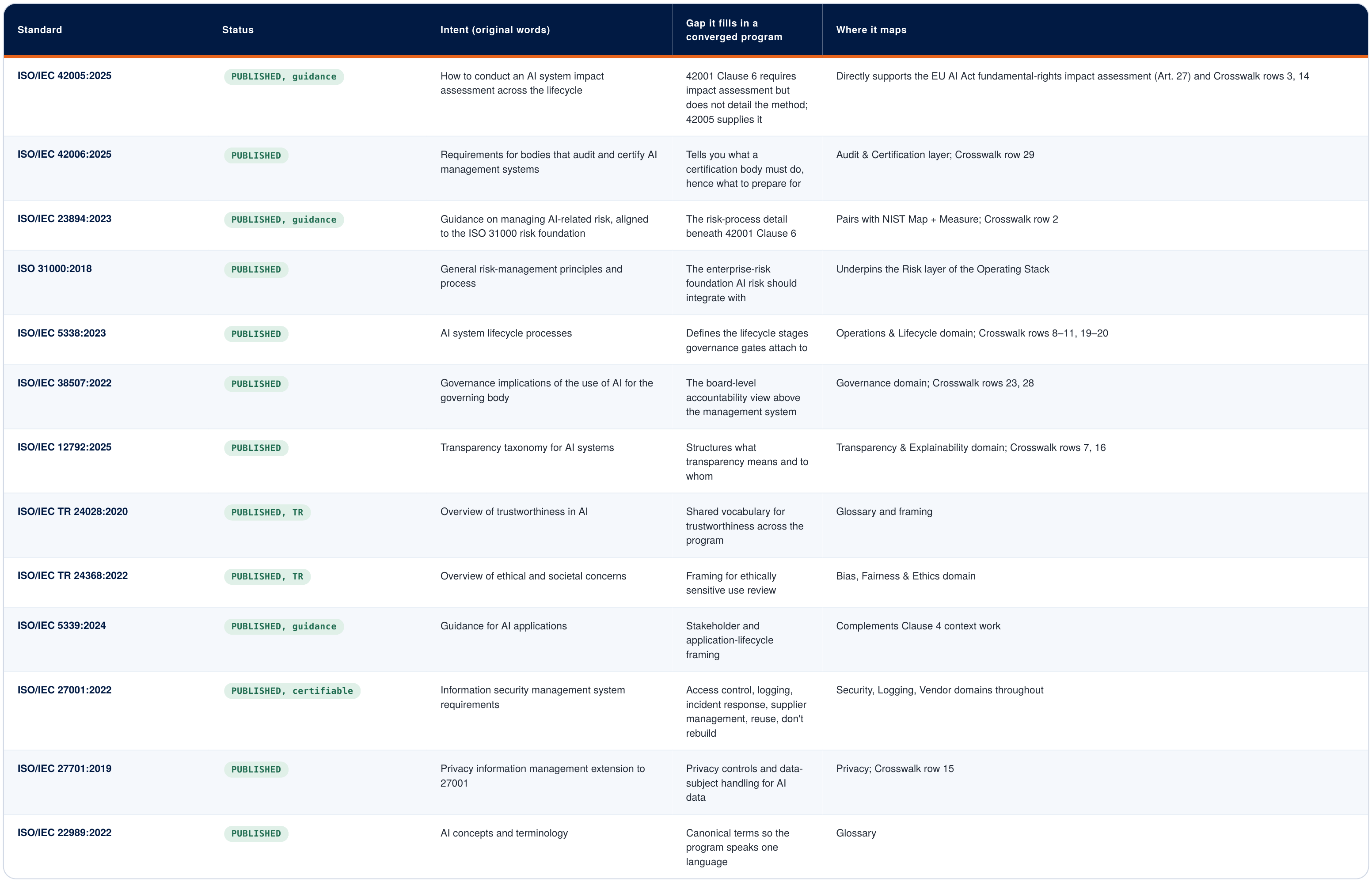
The single most valuable insight in this mapping is that an enterprise already holding ISO/IEC 27001 is not starting AI governance from zero. A large share of what AI governance requires, access management, logging and traceability, incident response, supplier due diligence, change control, business continuity, already exists in a mature ISMS and can be extended to cover AI rather than rebuilt. The converged program treats 27001 as a foundation and 42001 as the AI-specific layer above it, mapping existing controls forward and building only the genuinely new AI-specific controls (impact assessment, bias, drift, explainability, agentic autonomy) from scratch. This is both faster and cheaper, and it is why the sequencing in Part 10 begins with mapping what you already have.
This is the core deliverable. Each row is a governance capability every enterprise needs. The columns show where each instrument addresses it, what evidence satisfies all three simultaneously, who typically owns it, the key artifacts, an implementation priority, and practical notes.
How to read the references. EU AI Act references cite article numbers by intent. NIST references cite the four functions (GV=Govern, MP=Map, MS=Measure, MG=Manage). ISO references cite clause numbers (4–10) and Annex A control groups (A.2–A.10) by intent, no control text is reproduced. Priority is P1 (foundational, do first), P2 (core), P3 (maturity).
A machine-readable CSV of this matrix accompanies the guide.
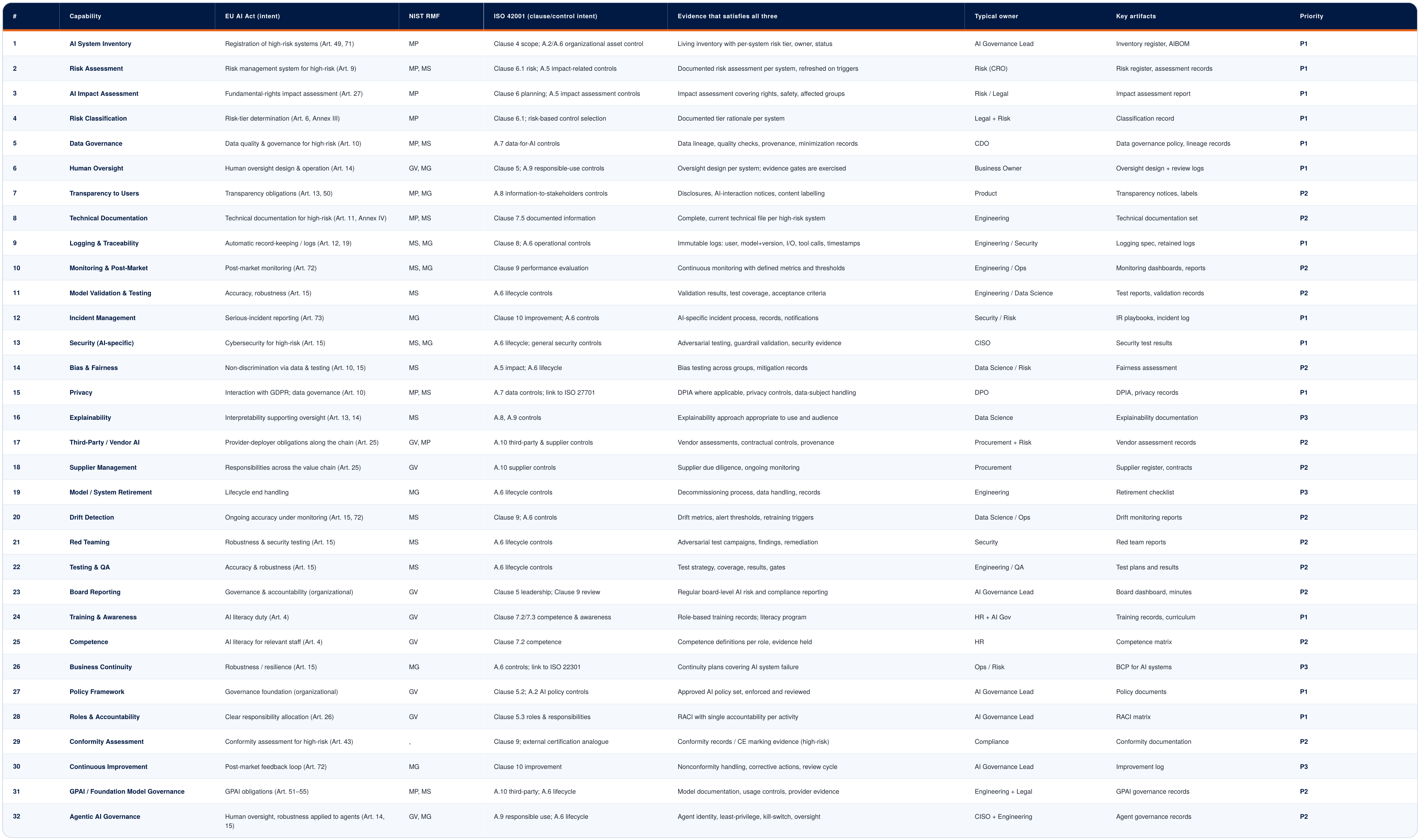
Using the matrix. Read each row as a single unit of work. The evidence column is deliberately written so one artifact satisfies all three instruments, build it once, map it three ways. Start with every P1 row; these are foundational and most other rows depend on them. The owner column is a starting default; adjust to your structure, but preserve the single-accountability principle from Part 9.
A complete implementation checklist of 260+ items, grouped by the thirteen governance domains. Each item is designed to be tracked with a Status (Not Started / In Progress / Complete / N/A), an Owner, Evidence (the artifact that proves it), and a Priority (P1/P2/P3).
The full checklist accompanies this guide as a CSV for direct import into a GRC tool or spreadsheet. What follows is the complete item set in reference form.
[P1][P1][P1][P1][P1][P1][P2][P1][P1][P2][P2][P2][P2][P3][P2][P1][P2][P2][P2][P2][P1][P1][P1][P1][P1][P1][P1][P2][P2][P1][P2][P2][P3][P2][P2][P2][P2][P2][P2][P1][P1][P2][P2][P2][P2][P2][P2][P2][P1][P2][P2][P1][P1][P1][P1][P1][P2][P2][P2][P2][P1][P2][P1][P2][P1][P1][P1][P1][P2][P1][P2][P2][P2][P1][P2][P2][P3][P1][P2][P1][P1][P2][P2][P1][P2][P2][P2][P2][P2][P3][P3][P2][P2][P2][P2][P1][P3][P3][P2][P3][P1][P1][P1][P1][P2][P2][P1][P1][P1][P2][P1][P2][P1][P2][P1][P2][P2][P1][P2][P2][P2][P2][P2][P2][P2][P2][P2][P2][P3][P2][P2][P2][P3][P2][P2][P3][P1][P1][P2][P1][P1][P2][P2][P2][P2][P2][P2][P3][P2][P1][P2][P2][P2][P2][P2][P1][P2][P1][P1][P2][P2][P1][P2][P2][P1][P2][P2][P2][P1][P2][P2][P2][P3][P3][P2][P2][P2][P1][P1][P1][P2][P2][P2][P2][P1][P2][P3][P2][P2][P2][P2][P2][P2][P2][P2][P2][P2][P3][P3][P2][P2][P2][P2][P3][P1][P1][P2][P1][P2][P2][P2][P1][P2][P2][P2][P3][P1][P2][P1][P1][P3][P2][P2][P2][P3][P2][P2][P2][P2][P2][P2][P2][P3][P2][P1][P2][P2][P2][P1][P1][P1][P1][P1][P2][P2][P2][P1][P1][P1][P2][P1][P1][P1][P2][P2][P2][P2][P3][P2][P2]The board governs AI through a small set of metrics that translate operational governance into executive language. The dashboard below separates KPIs (are we governing well?), KRIs (what could hurt us?), and executive metrics (where do we stand strategically?).
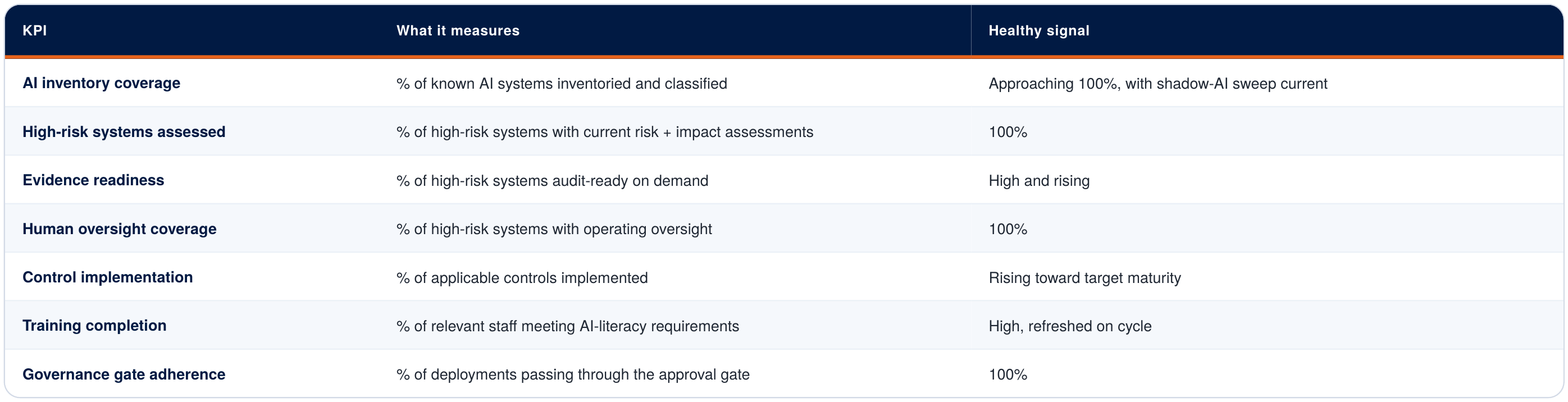
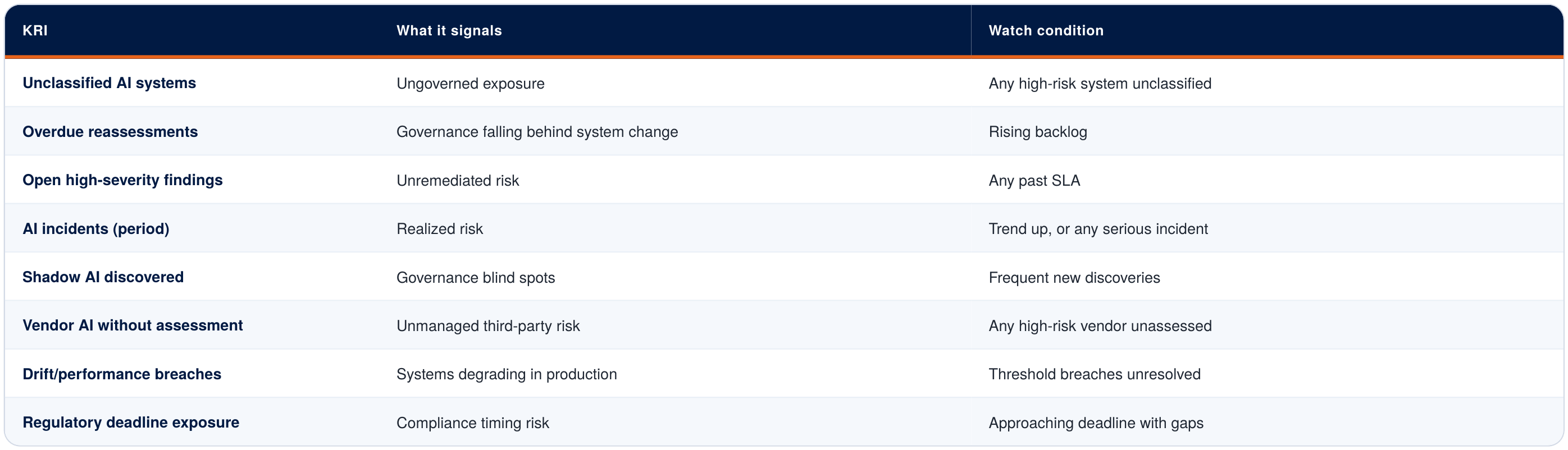
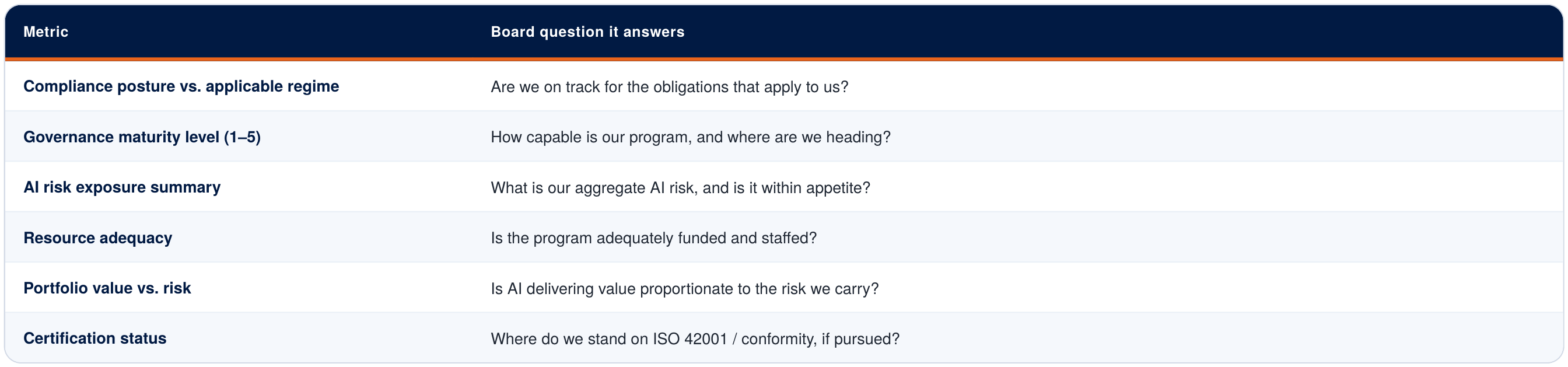
Reporting cadence. KRIs and incidents: every board meeting. KPIs and maturity: quarterly. Full governance review: at least annually, or on material change (major incident, new regulation, significant new high-risk deployment). Keep the board view to one page; depth lives in the operating layers beneath.
Five levels describe the journey from ad hoc to optimized. Each level defines what is true of the organization, and what it must do to advance.
Level 1, Initial (Ad Hoc). AI is used without systematic governance. No inventory, no defined ownership, no consistent risk assessment. Governance happens reactively, if at all. Shadow AI is unknown and unmanaged. Characteristic: the enterprise cannot answer "how many AI systems do we run, and what are their risks?" To advance: establish ownership, run an inventory sweep, secure executive sponsorship.
Level 2, Developing (Repeatable). Basic governance exists for some systems. An inventory has begun, a policy exists, and high-profile systems get risk assessments, but coverage is partial and processes are inconsistent. Governance is owned but under-resourced. Characteristic: governance exists but is not yet comprehensive or reliable. To advance: build the single control framework, extend coverage to all high-risk systems, stand up the operating model.
Level 3, Defined (Established). Governance is systematic and documented. A complete inventory, consistent risk and impact assessments, a defined operating model with clear ownership, an evidence repository, and a functioning approval gate. The program maps to all three instruments through one framework. Characteristic: governance is comprehensive, consistent, and evidence-generating. To advance: mature monitoring and measurement, pursue certification if valuable, deepen technical controls.
Level 4, Managed (Measured). Governance is measured and continuously monitored. Metrics drive decisions, monitoring is continuous, drift and performance are tracked, and the board receives meaningful reporting. Controls are validated for effectiveness, not just existence. Certification may be achieved. Characteristic: the enterprise knows quantitatively how well it governs and where risk sits. To advance: optimize based on data, automate evidence, lead rather than follow regulatory change.
Level 5, Optimized (Leading). Governance is a strategic capability and a source of advantage. It is largely automated, continuously improving, and anticipates regulation rather than reacting to it. Evidence is generated automatically as a byproduct of operation. The enterprise contributes to standards and sets industry practice. Characteristic: governance enables faster, safer AI adoption than competitors can achieve. Sustained by: continuous improvement, horizon scanning, and cultural embedding.
Using the model. Assess honestly against the definitions. Most enterprises deploying AI at scale are between Level 1 and Level 2 today. Level 3 is the realistic near-term target and the point at which the program becomes genuinely defensible. Level 4–5 are differentiators. Advance one level at a time; skipping levels produces fragile governance that fails under audit or incident.
Governance succeeds or fails on ownership. This operating model assigns every governance responsibility to a role, following one cardinal rule: exactly one accountable owner per activity. Others are consulted or informed, but accountability is never shared, shared accountability is no accountability.
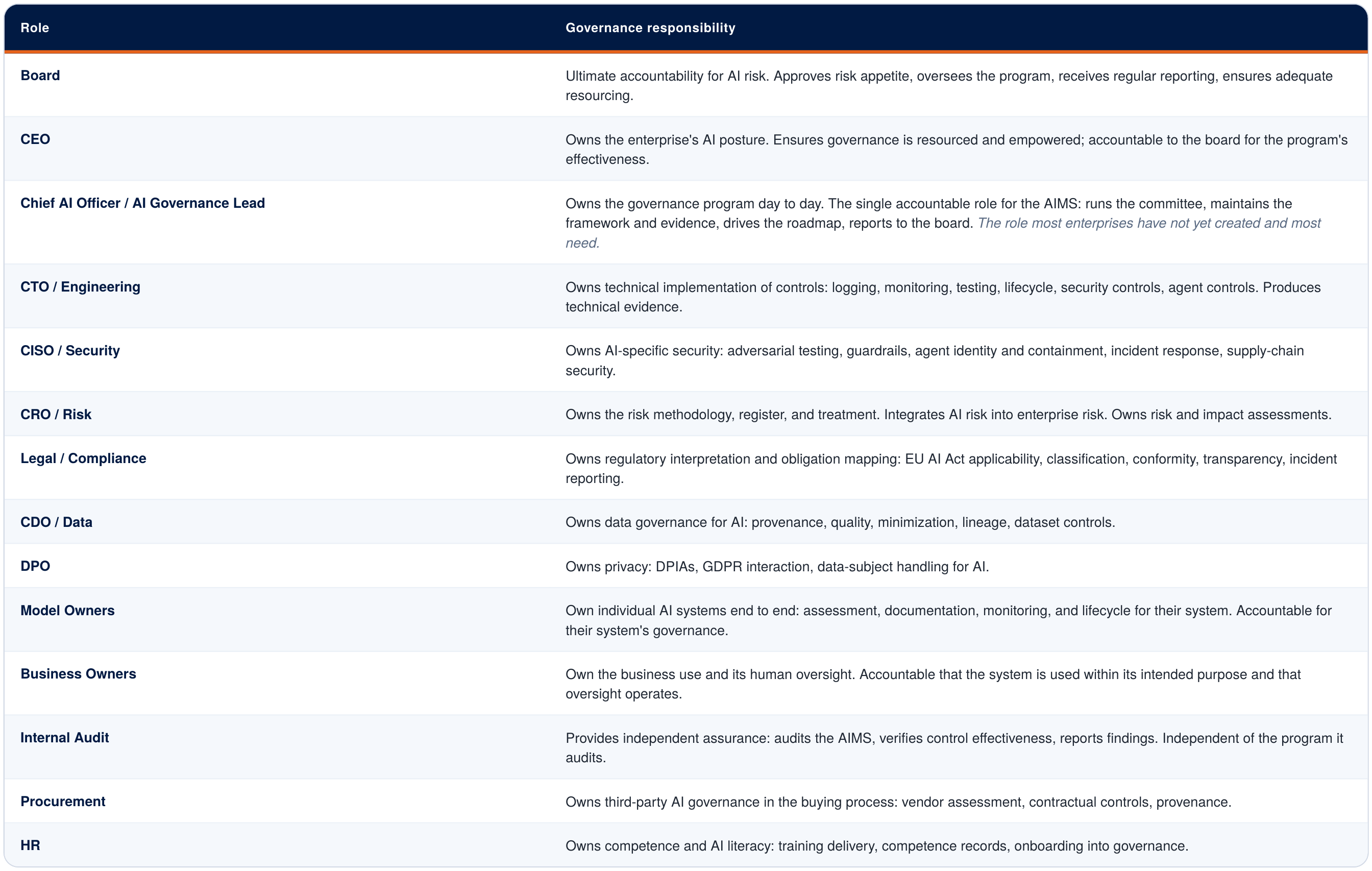
The committee. These roles convene as an AI governance committee chaired by the AI Governance Lead, reporting to the board. The committee is where cross-functional decisions are made, classification disputes, high-risk approvals, exception requests, and where the single-accountability principle is enforced in practice.
The critical appointment. If one thing is missing in most enterprises, it is the AI Governance Lead, a single named owner for the whole program. Without it, governance work scatters across functions that each own a piece and none owns the whole, which is precisely the parallel-programs failure from Part 2. This role can be fractional in smaller enterprises, but it must exist and must be named.
A phased path from standing start to operating program. Each phase has a theme, concrete deliverables, and an exit criterion. Phases build on each other; do not start a phase before its predecessor's foundations are in place.
Theme: know what you have and who owns it. - Appoint the AI Governance Lead and secure executive sponsorship. - Stand up the AI governance committee. - Run an initial AI system discovery sweep, including shadow-AI detection. - Build the first version of the AI inventory with owners assigned. - Draft the enterprise AI policy. - Determine EU AI Act applicability at the enterprise level. - Exit criterion: a named owner, a committee, and a first inventory exist. The enterprise can now answer "what AI do we run?"
Theme: establish the single control framework and classify risk. - Adopt the single control framework mapped to all three instruments (the Crosswalk). - Classify each inventoried system by EU AI Act risk tier and record rationale. - Stand up the risk register and risk methodology. - Establish the evidence repository and evidence model. - Build the RACI with single accountability per activity. - Define the deployment approval gate. - Exit criterion: every system is classified, the control framework is adopted, and the approval gate is live.
Theme: implement P1 controls where risk is highest. - Run risk and impact assessments for all high-risk systems. - Implement human oversight for high-risk systems. - Implement logging and traceability to the required standard. - Establish data governance for AI. - Stand up AI-specific incident response and playbooks. - Implement Article 50 transparency and Article 4 AI-literacy obligations (live in 2026 regardless of the high-risk deferral). - Exit criterion: high-risk systems have current assessments, operating oversight, adequate logging, and the enterprise meets its 2026-applicable EU obligations.
Theme: extend coverage and validate effectiveness. - Implement monitoring and measurement (performance, drift, bias, security). - Conduct adversarial testing / red teaming of high-risk and agentic systems. - Complete vendor assessments for third-party AI. - Stand up training and competence programs. - Conduct the first internal audit of the AIMS. - Deliver the first full board dashboard. - Begin ISO 42001 preparation if certification is pursued. - Exit criterion: governance is comprehensive across the portfolio, monitored, and independently assured. The program is at Level 3 maturity.
Theme: measure, certify, and improve. - Complete ISO 42001 certification if pursued. - Prepare conformity assessment approach for high-risk systems ahead of the 2027/2028 deadlines. - Mature monitoring to continuous, metric-driven operation. - Automate evidence generation where possible. - Establish horizon scanning for regulatory change. - Run the annual governance review and refresh the roadmap. - Exit criterion: a measured, improving program (Level 4), certified if pursued, and positioned ahead of the high-risk deadlines rather than racing them.
On the EU timeline and sequencing. The high-risk deferral to December 2027 (Annex III) and August 2028 (Annex I) gives enterprises breathing room on the heaviest regime, but the 2026 transparency and literacy obligations are not deferred, and the durable machinery takes time to build. The right response is to use this roadmap to reach Level 3 on the ISO/NIST foundation now, so that high-risk conformity becomes a byproduct of an operating system rather than a last-minute project.
Nine reusable templates translate the framework into working artifacts. Each is described here in structure; all accompany the guide as ready-to-use files. All are original and reproduce no standard's text.
Fields: system ID; name; description; owner; business function; provider/deployer role; underlying models and versions; data sources; risk tier; deployment status; environments; dependencies; last assessment date; next review trigger; evidence location.
Fields: risk ID; linked system; risk description; category; likelihood; impact; inherent rating; controls; residual rating; owner; treatment plan; acceptance decision and approver; review date.
Sections: model identity and version; intended purpose and out-of-scope uses; training data summary and provenance; performance and accuracy; limitations; fairness assessment; security testing summary; human oversight design; monitoring approach; owner and review cycle.
Sections: system and owner; risk classification and rationale; risk and impact assessment reference; controls implemented; human oversight design; testing and validation results; residual risk and acceptance; approver and decision; conditions and review date.
Sections: system and its decisions; oversight roles and authority; intervention and halt capability; information provided to overseers; automation-bias safeguards; mandatory-approval conditions; competence of overseers; oversight logging; effectiveness validation.
Sections: incident ID and severity; systems affected; detection and timeline; what happened; impact (data, individuals, business); containment and remediation; root cause; regulatory-notification decision; corrective actions; lessons fed back into risk and controls.
Sections: vendor and service; AI components and models; provider/deployer obligation split; security posture; data handling; governance maturity; provenance; contractual controls (audit rights, incident notification); assessment outcome and conditions; review cycle.
Items: decommissioning approval; dependency and downstream impact check; data handling and retention/deletion; access revocation; documentation archival; stakeholder notification; evidence retention; confirmation of clean termination.
Sections: inventory completeness; classification accuracy; assessment currency; control implementation and effectiveness; evidence readiness; oversight operation; monitoring operation; incident-process readiness; training completion; nonconformity and corrective-action status.
An A1 landscape infographic accompanies this guide as a print-ready SVG. It renders the governance flow as a single memorable visual:
The integration flow (top band): EU AI Act (what you must prove) → ISO/IEC 42001 (how you operate) → NIST AI RMF (how you reason) → converging into Enterprise Controls → generating Evidence → supporting Audit → enabling Certification & Conformity → sustained by Continuous Monitoring, which loops back to controls.
The altitude model (left): the three instruments shown at their altitudes, Obligation (law), Operation (management system), Reasoning (risk framework), making visually clear that they are complementary layers, not competitors.
The operating stack (center): the ten-layer stack from Part 13, shown as a vertical spine.
The maturity ladder (right): Levels 1–5, as a rising path.
The poster is designed so a board member grasps the whole model in one glance and an implementer can use it as a wall reference. It is provided in the CXO Intelligence palette.
Standards tell you what good governance includes. They do not give you a single mental model for how the pieces stack into an operating system. The AI Governance Operating Stack is that model, an original, reusable framework that any enterprise can adopt. It arranges governance into ten layers, each depending on the ones below it, each with a clear question it answers, an owner, and an output that feeds the layer above.
The organizing insight: governance is a stack, not a checklist. Value flows up (each layer enables the next) and evidence flows down (each layer proves the intent of the one above). A weakness at any layer undermines everything above it, which is why programs that start at the control layer, skipping strategy and policy, produce controls nobody can trace to a purpose.
Question: why are we using AI, and what is our risk appetite? The foundation. Defines the enterprise's AI ambition, the value it seeks, and the risk it will accept. Owned by the board and CEO. Without this layer, governance has no reference point for any decision. Output: AI strategy and risk appetite.
Question: what are our rules? Translates strategy into enforceable rules, the AI policy set covering acceptable use, approval, data, and third-party AI. Owned by the AI Governance Lead. Output: approved, enforceable policies.
Question: what could go wrong, and how much does it matter? The reasoning engine (this is where NIST's Map and Measure live). Identifies, assesses, and prioritizes AI risk per system and across the portfolio. Owned by the CRO. Output: risk register, assessments, treatment decisions.
Question: what do we do about it? Converts risk decisions into specific controls, the governance capabilities in the Crosswalk. This is where ISO Annex A control selection and the EU AI Act obligations become concrete measures. Owned jointly, coordinated by the AI Governance Lead. Output: an implemented, mapped control set.
Question: how do we implement controls in the systems themselves? The technical realization: logging, monitoring, testing, guardrails, agent identity, lifecycle tooling. Owned by Engineering and Security. Output: technical controls operating in production.
Question: how do we prove it? The layer most programs neglect and auditors care about most. Evidence must be generated as a byproduct of operation, mapped once to all instruments, and audit-ready on demand. Owned by the AI Governance Lead. Output: a living evidence repository with an artifact-to-control index.
Question: is it still working? Makes governance continuous. Tracks performance, drift, bias, security, and behavior against thresholds, feeding breaches back into the risk layer. Owned by Engineering and Operations. Output: continuous monitoring with alerting and feedback.
Question: can we independently trust it? Independent verification that controls are not just present but effective. Internal audit and management review. Owned by Internal Audit, independent of the program. Output: assurance findings and validated effectiveness.
Question: can a third party confirm it? External validation: ISO 42001 certification, EU conformity assessment, regulatory examination. Owned by Compliance. Output: certification and conformity records.
Question: how do we get better? Closes the loop. Nonconformities, incidents, monitoring insights, and audit findings drive continual improvement, feeding back to strategy. Owned by the AI Governance Lead. Output: an improvement cycle that raises maturity over time.
Why the stack works. It gives every stakeholder a shared map. The board engages at Layers 1 and 10 (strategy in, improvement out). Engineers work at Layers 5 and 7. Auditors work at Layers 8 and 9. Everyone sees how their work connects to the whole, and every control traces down to a risk and up to a purpose. Adopt it as the enterprise's canonical governance model, and the three instruments stop being three programs, they become inputs to one operating system: NIST informs Layer 3, ISO structures Layers 2–10, and the EU AI Act sets requirements that shape Layers 4 and 9.
The differentiator. A decision tool that tells any enterprise which obligations actually apply to it, which controls become mandatory, what evidence to collect, and who owns it.
Most governance content describes the landscape. The Navigator routes you through it. It is a structured decision tool: answer a sequence of questions about your AI use, and it outputs your applicable obligations, mandatory controls, required evidence, responsible owners, and remaining gaps. A full interactive version accompanies this guide; the logic is below so it can be applied directly or built into a tool.
The Navigator asks a sequence of gating questions. Each answer activates obligations, controls, and owners. At the end, it assembles your profile.
(biometrics, critical infrastructure, education, employment, essential services, law enforcement, migration, justice, or AI as a safety component of a regulated product) - Yes (Annex III, stand-alone) → the full high-risk regime applies: risk management, data governance, technical documentation, logging, human oversight, accuracy/robustness/security, conformity assessment, registration. Deadline: 2 December 2027. Owner: cross-functional, led by AI Governance Lead. - Yes (Annex I, embedded in regulated product) → high-risk regime plus sector product rules. Deadline: 2 August 2028. Owner: cross-functional + product compliance. - No, but limited-risk → transparency obligations (Art. 50) and AI-literacy duty (Art. 4). Deadline: 2 August 2026, not deferred. Owner: Product + HR. - No, minimal risk → no specific EU obligations, but baseline governance still recommended.
After the questions, the Navigator assembles a profile:
A European bank building an AI system to assist credit decisions, using a foundation model, wanting ISO certification, not yet using agents:
Output: high-risk EU obligations + BFSI sector rules + GPAI governance + full ISO AIMS. Mandatory controls include (Crosswalk rows) risk management, data governance, technical documentation, logging, human oversight, accuracy/robustness/security, conformity assessment, plus bias/fairness given credit context. Evidence: the full high-risk technical file, impact and fundamental-rights assessments, oversight design and logs, validation and bias-testing records, conformity documentation, and the ISO Statement of Applicability. Owners: cross-functional, AI Governance Lead accountable, with model risk (CRO) and Legal heavily engaged. Priority gaps surface as P1 first. Target: Level 3 maturity well ahead of the December 2027 deadline.
Why the Navigator matters. It converts a generic framework into a specific, actionable roadmap for one enterprise's exact situation, which regulations, which controls, which evidence, which owners, which gaps. That specificity is what makes it usable rather than merely informative, and it is what makes the difference between a reference that sits on a shelf and a tool a practitioner returns to.
The three instruments, the EU AI Act, ISO/IEC 42001, and the NIST AI RMF, are not three programs to run in parallel. They are three views of one governance reality: what you must prove, how you operate, and how you reason. Build the machinery once, generate evidence once, map it three ways, and you satisfy all three, and position yourself for whatever comes next.
The high-risk deadline moving to December 2027 changed the timing, not the destination. The enterprises that use this window to build durable governance on the ISO and NIST foundation, rather than treating the deferral as a reprieve, will meet the deadline as a formality and will govern AI as a capability rather than a compliance burden.
That is the difference between compliance and governance. Compliance is passing an inspection. Governance is being the kind of organization that would pass any inspection, because the machinery is real, the evidence is a byproduct of operation, and someone is genuinely accountable.
The Enterprise AI Governance Crosswalk · A CXO Intelligence: Governance Series Companion Reference · Leadership in the Age of AI
This guide reproduces no copyrighted standard text. All clause and article references are pointers to source documents, which should be consulted directly for normative wording. Regulatory timelines and standard statuses reflect mid-2026; verify against current sources before formal use.
Cite as: Akhawat, P. (2026). The Enterprise AI Governance Crosswalk (CXO Intelligence: Governance Series, Companion Reference to Article 4). akhawat.com
Subscribe to the CXO Intelligence Series on LinkedIn: https://www.linkedin.com/newsletters/cxo-intelligence-series-7475953227239419904/
Follow Prashant Akhawat: https://www.linkedin.com/in/prashantakhawat/
All Articles in the Series: https://akhawat.com/writing