
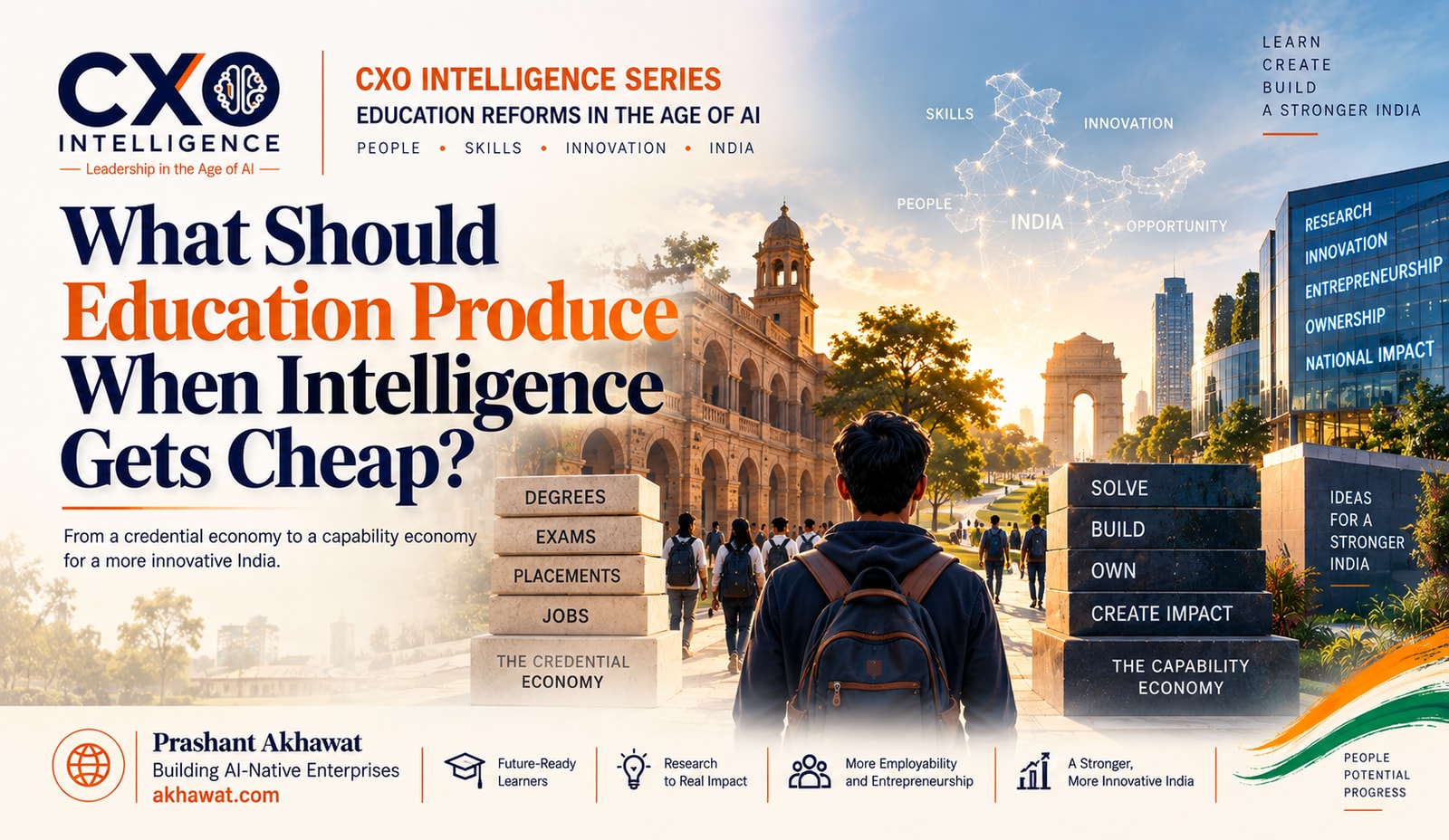
By Prashant Akhawat. CXO Intelligence Series, Education Reforms in the Age of AI. September 2026.
India built one of the world's largest credential machines. It worked. The economy it was built for is now being repriced, and the thing the machine produces is no longer the thing that is scarce.
Here is the contradiction that runs through this article.
India has never had more educated people. Enrolment in higher education sits around 4.5 crore. Doctoral enrolment tripled in a decade. India ranks ninth in the world for high-quality research output. Patent filings at the Indian office have grown for eight consecutive years, driven by resident applicants. The country has built national AI compute, funded indigenous models, and created a new apex research foundation with a lakh crore of patient capital behind it.
The inputs are enormous. And nobody in India can tell you how much of them converted into anything.
Not as an accusation. As a literal statement about data. No national dataset tracks university licensing income, technology transfer revenue, or how many spin-outs are still trading after five years. NIRF counts filings and grants. The conversion side is simply not measured, which means the country cannot answer the only question that matters about all that input.
That absence is where this argument starts, because a system measures what it is optimized to produce.
It is worth being fair to what was built before criticizing it. India's education system was a rational answer to a real economic question. A technology services industry that will touch around 315 billion dollars this year needed trainable people at enormous scale, and it needed a trustworthy signal of who was trainable. The degree was that signal. The affiliating university standardized it, the entrance examination sorted for it, the placement percentage measured it, and the corporate training floor closed whatever gap remained. Every part fit.
The system did not fail. It succeeded at a specific objective, and it is still succeeding at it.
What has changed sits underneath. That industry sold skilled human hours, and the scarce input in an hour of professional work was the cognition inside it. As machines get better at producing that cognition, the scarcity moves. It does not disappear. It relocates, toward the things a model cannot supply. Which problem is worth solving. Access to data nobody else holds. Physical validation. Regulatory trust. Distribution. And, at the end of all of them, ownership of the result.
This is not an argument that AI is destroying Indian technology jobs. Revenue and headcount are both still growing, and the industry is rapidly adopting AI. It is an argument about where margin sits over a decade. If I am wrong, the observable signal will be that returns to owning products and IP stay flat relative to returns to supplying skilled hours. That is testable, and I would change my view on it.
But if the scarcity is relocating, then a system optimized to certify trainability is optimizing for the wrong thing, and no amount of improving it helps. You do not fix an objective function by running it better.
Which reframes the question that education reform in India keeps asking. The question has been how to make more graduates employable. That is a question about throughput. The real question is prior to it, and it is the one this article is built around.
What should education produce when intelligence gets cheap?
I write this from the hiring side rather than the teaching side. For more than two decades I have built technology organizations and recruited from this system. The pattern I keep meeting is not a shortage of ability. It is bright people, well trained in one discipline, who have never once been asked to own a problem from definition to something that works.
That is not a criticism of them. It is a description of what they were certified for.
Part I. When knowledge was scarce
For most of the history of the university, knowledge was expensive and hard to reach, and the institution existed to transfer it. Everything about the modern degree descends from that condition. The lecture, the syllabus, the semester, the written examination, the credit hour. All of it assumes that absorbing a body of knowledge and reproducing it under supervision is a meaningful test, because it was.
That assumption held for eight centuries and started coming apart inside three. The examination increasingly certifies a cognitive task that machines now perform remarkably well.
So what is scarce instead? Not knowing things. Judging which problem is worth the effort. Framing it so it can be attacked. Assembling the right combination of people and methods. Building something. Producing evidence that convinces someone who was not there. And being accountable when it fails.
None of those is knowledge transfer. Every one of them is capability, and the Indian degree certifies almost none of it.
The examination increasingly certifies a cognitive task that machines now perform remarkably well.
This is why the four numbers everyone quotes about Indian education are symptoms rather than the disease, and why each deserves its counter-reading before being used as evidence.
Graduate unemployment runs at 11.2 percent against a national rate of 3.1 percent. The fair objection is that India's national rate is low because poor Indians cannot afford to be unemployed and take subsistence work instead, so graduate unemployment partly measures the ability to queue for a formal job. True, which is why the sharper number is the trend. In 1983 roughly one in eight unemployed young Indians held a degree. Today it is close to two in three. A within-category shift of that size over four decades is not explained by reservation wages.
Employability, usually cited at 56 percent, comes from a commercial assessment administered by an employability testing firm to a self-selected pool. It is industry's view of its own hiring pool, which is useful. It is not a population statistic and should be read as a signal.
Only about a third of approved M.Tech seats were filled in the most recent AICTE series. The strongest objection is that students are behaving rationally, since a degree that adds no wage premium over two years of work experience should have empty seats. I accept that entirely. It is the reason the degree needs redesigning rather than defending.
And the national AI mission selected 150 students in the first year of its undergraduate fellowship against a target of 5,000. A first-year scheme has ramp-up problems, and any of them could explain a gap. What none of them explains is the absence of a published diagnosis.
Part II. The Capability Economy
I want to name the destination, because the argument gets vague without a term for it, and then to define the term tightly enough that it can be argued with.
A Capability Economy is one where the unit of value is a solved problem rather than a certified person, and where institutions are measured by what their people can make happen rather than by what those people have completed.
It is not a synonym for a skills economy, and the difference is the whole point. A skills economy still sells the person, priced by what they know how to do. A Capability Economy sells what the person and their institution can produce and own. One rents cognition. The other accumulates assets.
Three properties follow.
Value attaches increasingly to what the person can solve, build and own, not simply to the credential they hold. In a credential economy a graduate is priced by their degree and their institution's brand. In a Capability Economy they are priced by problems they have solved and evidence they carry, which is why a portable record of demonstrated work matters more than a transcript.
Capability appears in combinations. A single deep skill is a commodity input, and the market prices commodities accordingly. Capability shows up where two or more competencies meet inside one person or one tight team, because unsolved problems tend to sit exactly where disciplines do not meet.
Capability compounds only where it is measured. Institutions move toward whatever is counted, quickly and reliably. India demonstrated this with patent filings, which rose sharply once filings began to count in rankings. The same responsiveness is available for conversion outcomes, and is currently pointed at nothing, because nobody counts them.
Which brings the two economies into direct comparison. The credential path runs student, course, examination, degree, placement, job. The capability path runs problem, knowledge, experiment, team, build, evidence, research, deployment, ownership.
Notice that the second path does not delete the first. Knowledge is still in it, and so is research. What changes is position. Knowledge is no longer the destination. It is an input, arriving when a problem demands it rather than in the order a syllabus prescribes.
And notice where the second path ends. Ownership, not employment. That is the word that connects an education argument to an economic one, and it is the reason this matters beyond universities.
The conversion gap
Between what India has and what India gets, there is a measurable gap, and it has five joints. Education to capability. Research to intellectual property. IP to products. Products to companies. Companies to national value.
India has scale at the front of the chain and thins out through the middle. Doctoral enrolment tripled in a decade to about 3.43 lakh. India placed ninth in the 2024 Nature Index, though the Index is volume-weighted and concentrated in a handful of institutions, and India ranks far lower per researcher. Concentrated excellence beside thin average quality is not a contradiction of the argument. It is the argument.
On patents, I want to correct a claim I have made before, because the data does not support it. Filings at the Indian office have grown for eight straight years, driven by resident applicants, and India is now among the largest filing offices in the world. The evidence does not support the claim that Indian patenting is weak. WIPO data shows sustained growth in filings by resident applicants.
The problem is that a patent count is the wrong instrument. A patent is an input to commercialization, not evidence of it. The measures that would settle the question are licensing income, technology transfer revenue and five-year spin-out survival. India publishes none of them.
That absence is the finding, and it is also what would falsify this article. If Indian institutions were licensing research and producing surviving companies at rates comparable to peer systems, the thesis fails. The reason neither of us can check is that nobody is counting.
India does not have a shortage of credentials. It has a conversion gap, and the clearest evidence is that nobody measures conversion.
One tension in my own argument needs resolving rather than hiding. I have said money is not the constraint. That is too neat. Research intensity at 0.84 percent of GDP against an OECD average near 2.7 is genuinely too low, and that is a money problem. The newest instruments cannot absorb what they have already been given, and that is a different problem. Treating the two as one problem is how policy gets built badly.
Part III. What next-generation education means
The phrase gets used loosely, so here is a definition that does some work.
Next-generation education is education organized so that a student's progression is driven by problems rather than by courses, and so that what the student can do is evidenced rather than asserted.
That single organizing choice produces the rest. A problem does not respect departments, so the work becomes interdisciplinary. A real problem has no answer key, so it becomes research-connected. The problem lives somewhere, so it becomes connected to a laboratory, a hospital or a firm. The tool is simply present in how work gets done, so it becomes AI-native. And someone outside the department has to be convinced, so it becomes evidence-based. None of those properties has to be mandated separately. They fall out of the first choice.
What it does not mean is less depth. A student who has dabbled across five fields and mastered none is worse prepared than a conventional graduate, not better.
Here the evidence needs stating precisely, because the usual version of this argument overreaches. Analyzing 17.9 million papers, Uzzi and colleagues found that the highest impact science rests on deeply conventional foundations with a small injection of unusual combinations. The same literature shows interdisciplinary proposals win funding less often, across more than 18,000 Australian Research Council applications, and are cited more slowly in early years.
What that establishes is a property of published research, not of curriculum. It does not show that training undergraduates in two disciplines increases the supply of people who make such combinations. That link is a hypothesis. I hold it because the combination has to come from somewhere and currently arrives by accident, but it is a hypothesis and I would rather say so than have an academic say it for me.
What the evidence does establish firmly is the design implication. Work of this kind is simultaneously the most valuable and the most penalized by short-horizon metrics. It will not appear because individuals are brave. It appears when degree structures, funding units and appointment rules make it the default path rather than the costly one.
The four objections this architecture has to survive
Who teaches the second discipline? Central universities alone carry thousands of vacant teaching posts. Three mechanisms, none of them new. Shared faculty appointments, so one academic counts in two departments, which is how MIT built its computing school. Industry adjuncts, of whom Bengaluru and Hyderabad have tens of thousands. And AI tutors carrying foundation-year drill, which is where teaching load is heaviest. The faculty shortage is a reason to design this way rather than a reason to wait.
How does external evaluation scale? It does not, if you imagine a crore of students a year each judged by an external practitioner. Start with centrally funded institutions and the top two hundred, roughly a hundred thousand students, which is within reach of the practitioner pool already sitting on advisory boards. A proposal with an implausible denominator gets dismissed on arithmetic before anyone engages the idea.
Is project assessment not more vulnerable to AI than an examination? This is the sharpest objection to the whole argument. Yes, a submitted artifact is easier to fake than a proctored paper. Which is why the assessment is not the artifact. It is the defense of the artifact, oral, before someone who knows the domain, with the tool present and permitted. You cannot fake the ability to explain why you rejected the other three approaches. The shift is not from examinations to submissions. It is from written recall to defended judgment.
Does this concentrate advantage in metros? It could, and this is the risk I take most seriously. External problems and practitioner examiners cluster in a dozen cities. But the scarce input is examiners, not problems. A district college has no shortage of authentic problems and arguably a better supply than a metro campus insulated from them. The fix is regional and remote moderation panels. Design that in from the start or the model widens the gap it claims to close.
The school end, and why it is not an afterthought
India has the scaffolding already. Tinkering labs in thousands of schools, a national innovation mission, and curricular flexibility that schools do not use. What is missing is academic weight. What is not graded is not taken seriously by a system that trains people to optimize for grades, so the lab stays a room the toppers skip on the way to coaching.
The lever is the board examination. Give the Class 12 assessment an externally moderated project with real weight and the years beneath it reorganize. Leave it alone and nothing upstream survives contact with the entrance examination.
The assessment design matters more than the mandate. If you grade a venture on traction, you grade the student's family network. A child whose uncle runs a factory will always show better early traction than a child in a district school with identical ability. Grade the problem definition, the build, the method, what was learned from users, the technical rigor, the ethical reasoning and the honesty of the post-mortem. A sixteen year old with no connections can do all of those extremely well.
This is entrepreneurial capability, not startup privilege, and certainly not a claim that every student should found a company. Most will not and should not. The capability to define a problem, build toward it and prove what happened is as valuable inside a laboratory or a government department as it is inside a venture.
Grade a venture on traction and you grade the student's family network.
Part IV. Two instruments
Principles do not change institutions. Instruments do. Two of them carry most of the weight here, and both are proposals rather than proven interventions.
The Capability Degree
A Capability Degree is a four-year undergraduate degree in which a student develops deep mastery of one discipline, working fluency in a second, and demonstrates both by solving a real external problem and defending the result to someone outside the institution.
It is a different certification philosophy rather than a different course list. A conventional degree certifies exposure. This certifies demonstrated capability, and the distinction shows up in what an examiner is allowed to accept as proof.
One principle governs it. Depth first, combination second, evidence always. Every condition follows from that sentence, and any condition that does not serve it should be dropped.
The exclusions matter more than the inclusions, because every failure mode of this idea is a partial adoption. Add a second subject without depth and you produce a weaker graduate. Add a project without external evaluation and you produce an unverifiable one. Add a record without an artifact and you have produced a longer transcript. Seven conditions define the standard. Implementation can be phased, but the certification cannot become a renamed B.Tech.
The obvious objection is that I have just argued regulation does not change behaviour and am now proposing regulation. The difference is worth stating. A rule with nothing attached is a notification. A standard tied to funding eligibility, ranking weight and a published annual list is a price signal. Institutions responded to patent filing incentives within three years because filings were counted and rewarded.
Where such degrees sit follows from where India's problems and markets overlap. Clinical Systems Engineering. Computational Life Sciences. Materials Intelligence. Autonomous Systems. Agricultural and Earth Intelligence. Energy Systems Intelligence. Neural and Cognitive Engineering. Computational Governance. Financial Systems and Computation. Sovereign Computing Systems. The list is illustrative and is not the contribution. The standard the name carries is.
One already exists in substance. IIT Madras founded a Department of Medical Sciences and Technology in 2023 and runs a four-year BS in Medical Sciences and Engineering taught jointly by medical and engineering faculty, alongside a PhD for practising doctors and an MD-PhD with Sri Ramachandra. Built in India, in three years, by an engineering institute that decided the seam between medicine and engineering was worth owning. Few institutions have done anything comparable, and India's leading clinical institutions, which hold the patient populations and the public trust, have built almost nothing of the kind.
The Mission PhD
The conventional doctorate runs individual, supervisor, thesis, publication. The proposed one runs mission, cohort, individual thesis, shared infrastructure, external validation, deployment.
Concretely, twenty doctoral researchers and ten industrial master's engineers work on one national problem for five years. Two hosts, a university and a laboratory or company that owns the test infrastructure. AI agents as declared, logged and audited members of the team. Examination at years two and four by a panel that includes a practitioner, a regulator and one international member.
The individual owns the thesis. The cohort owns the mission.
Anyone who has supervised doctoral students will immediately ask how individual contribution is established when thirty people work on overlapping problems. Large physics collaborations spent decades solving this. The mechanism here has two parts. A signed contribution statement at each mission review, recording what each candidate specifically did, countersigned by the coordinator and the external panel. And an intellectual property allocation agreed at cohort formation rather than at the point of a licence, when incentives have diverged.
This is a design proposal, not a tested intervention. No controlled study compares cohort doctoral training against individual training on translation outcomes. What exists is analogous structure operating elsewhere for decades. Harvard-MIT Health Sciences and Technology since 1970. Stanford Biodesign since 2001. UK Centres for Doctoral Training, which fund cohorts rather than individuals. Singapore's industrial postgraduate programme, where the candidate is a salaried employee under joint supervision.
It also resolves a duration argument that is usually posed backwards. People propose cutting India's five-year doctorate to three. UGC regulations already set the minimum at three years. What does not exist is completion near it, with leading institutions running closer to four and a half to five and a half years. The fifth year comes from a problem scoped for publishability rather than completion, thin funding, and publication gating that the 2026 regulations have begun to address. A mission brief scopes the problem on day one. Cohort funding pays for the time. Mission reviews replace publication counts.
One qualification carries as much weight as the proposal. Not all research should be mission-driven. The missions of 2045 will rest on fundamental results from 2030 that nobody can commission today. CRISPR came from studying how bacteria defend themselves against viruses. A country that funds only what it can specify will invent only what it already knows it needs. My judgment, and it is a judgment, is roughly a third of doctoral funding in missions and two thirds investigator-driven, held by separate councils. The ratio is arguable. The firewall is not.
AI literacy is not AI capability
Between 2019 and 2026, many leading Indian institutions answered the AI question by creating new AI branches, schools, degrees and programmes. Useful, and not the same thing.
Literacy tells someone what AI can do. Capability means they can use it to change what their discipline can do. The first produces a doctor who knows a model exists. The second produces a doctor who can tell you why this one fails on their patient population, and redesign the workflow around that.
India needs AI engineers and has a growing supply. What it is short of is a sufficiently large supply of AI-enabled clinicians, materials scientists, agricultural scientists, regulators and policymakers. No AI department produces that supply, because the department is organized around the tool rather than around the discipline the tool is supposed to change.
A few institutions understood this. IIT Delhi's school of AI draws on faculty sitting in atmospheric sciences, civil engineering, biomedical engineering and management. IIT Bombay lets a student in any branch add AI as a minor, a specialization or a research master's. IIT Madras built the medicine and engineering department. The distinction between those and everyone else is not resourcing. It is where the capability was placed.
Literacy tells someone what AI can do. Capability means they can change what their discipline can do.
Part V. Why the university becomes the capability engine
Industry can hire skills. It cannot manufacture combinations.
The strong version of that claim is wrong and I want to state the defensible one. Industry can absolutely acquire the combination. It buys startups founded by such people, hires them internationally, and builds a handful internally. Six years of training is not a moat when an acquisition takes six months.
The asymmetry is narrower and more durable. Industry can acquire individuals. It cannot create a domestic supply, and it will not try, because training is a public good with heavy leakage. Whoever pays to build a bilingual engineer watches a competitor hire them. That is a textbook case for public provision, and the university is the institution that exists to provide it.
Two further advantages follow from where universities sit, and one of them I have previously overstated.
AI compresses the cognitive half of research and leaves the physical half untouched. Clinical trials, wet laboratories, field trials, fabrication and regulatory validation run at the speed they always ran. As thinking gets cheaper the bottleneck moves to validation.
Validation is a place, not a skill.
India sits beside one of the largest validation surfaces in the world. Patient populations at its major hospitals, field stations across every agro-climatic zone, test ranges and pilot plants inside national laboratories. The correction is that Indian universities do not hold that surface the way an American medical school holds its teaching hospital. AIIMS is not a university's hospital in that sense, defence ranges are security-restricted, and CSIR pilot plants belong to CSIR. The advantage is latent rather than held, which is precisely why a published validation registry would be worth more than another funding announcement.
And universities can hold problems with no quarterly return. Monsoon forecasting at district resolution. Antimicrobial resistance diagnostics. Sovereign silicon. Tuberculosis detection at the primary health centre. No buyer for a decade puts these structurally out of reach for any organization allocating against a roadmap.
Industry can acquire a combination. It cannot create a domestic supply of one, because the trainer never captures the return.
Part VI. What follows institutionally
One figure first, stated more precisely than I stated it before.
A parliamentary standing committee report laid before both Houses in August 2026 disclosed that the IndiaAI Mission selected 150 candidates against a target of 5,000 in the first year of its undergraduate fellowship, spent about 32 percent of its 2025-26 allocation, and then had its next allocation halved. That figure covers the undergraduate category specifically and should not be read across the whole programme.
On ANRF, a separate committee found nil utilization in 2023-24 and 2024-25. The first year is not evidence of anything, since ANRF was notified in February 2024 and its governing board first met that September. The year that matters is 2024-25, a full year after notification, with nil spend. Stacking a set-up year beside it weakens the point rather than strengthening it.
Which leaves a diagnosis rather than an accusation. Compute was the straightforward pillar. Talent is the hard one and it is running furthest behind.
If the argument holds, the institutional changes are not a wishlist. They are consequences, and each one reads as a principle before it reads as a policy.
If capability is what matters, it has to be counted. The Ministry of Education adds a second scorecard to NIRF covering artifacts built, licences, technology transfer income and spin-outs alive at five years, and begins collecting conversion data that does not currently exist.
If combinations are where capability lives, the degree has to require one. UGC defines the Capability Degree class with its seven conditions, tied to funding eligibility and ranking weight rather than issued as a notification.
If missions produce translation, funding has to move from individuals to cohorts. ANRF funds doctoral cohorts, requires contribution statements and IP allocation at formation, and writes the firewall protecting investigator-driven research into its charter.
If industry needs research capability, the master's has to become industrial research. AICTE converts a share of M.Tech seats into industrial research places. Start at a hundred companies and ten students each, not at national scale.
If clinical AI needs clinicians, medical education has to change. The National Medical Commission adds a statistics and data core in the first MBBS year, a clinical AI elective in years three and four, and recognizes a post-MBBS biodesign fellowship. None of it costs a clinical hour.
If absorption is the constraint, it has to be diagnosed before more is allocated. MeitY and IndiaAI publish an explanation of the first-year fellowship shortfall before announcing the next target.
If validation is the advantage, it has to be bookable. National laboratories publish a registry naming which hospital, field station, test range and pilot plant will host external academic work, on what terms and at what cost.
If building matters, boards have to assess building. CBSE and state boards give the Class 12 examination an externally moderated research project with real weight, assessed on method and evidence rather than on outcome.
If ownership is the destination, students have to be able to own things. The Ministry of Corporate Affairs creates a statutory exception for student ventures rather than a blanket age change, with guardian trusteeship, a capital ceiling, regulated sectors excluded and safeguards against fronting.
If autonomy enables all of it, affiliation has to shrink. State governments freeze new college affiliations and move a first cohort to graded autonomy with the fourth-year research requirement as a condition.
And if the placement calendar distorts the final year, institutions have to move it together. No single institution can shift placement to the end of year four without losing a recruiting cycle, which is why it has to be a consortium.
A policymaker will reasonably ask who moves first. The minimum viable coalition is three. NIRF changes what is measured. UGC changes what a degree must contain. ANRF changes what is funded. Those three together change the objective function itself, and most of the rest follows from institutions responding to it.
Why this would differ from NEP 2020
Any vice-chancellor reading this has watched a national policy promise four-year degrees, multidisciplinary flexibility and autonomy, and has watched adoption stall. The fair question is why this attempt would go differently.
NEP largely offered permissions. Institutions could adopt the four-year degree, could offer minors, could seek autonomy. Permissions without funding consequences or measurement change get absorbed by whatever the institution was already optimizing for, which was placements and rankings. Nothing in NEP changed either of those.
The three moves above are not permissions. They change what is measured, what is funded and what a degree must contain to be called one. If those three do not happen, the rest of this article describes a road not taken.
What education should produce
Return to the question. What should education produce when intelligence gets cheap?
People who can identify which problem is worth solving. People who can work across the boundary between two disciplines rather than inside one. People who can build something and defend the evidence for it to someone who was not there and is not inclined to agree. People who can turn research into capability, and capability into something a country owns.
And institutions built to let them, which is the harder half, because the students are already there.
India has never had more of the inputs. What it has not yet built is the conversion layer. That is partly a funding problem, but it is also a problem of what the system is optimized to produce, which is a choice, and choices can be changed.
The goal was never more graduates. It was always more people capable of solving problems that matter.