
Investigation Samsung Galaxy display failures Warranty policy
Seven Years of Software.
One Year of Warranty.
The smartphone is no longer sold as a two-year purchase. It is sold as a long-lived platform, with as much as seven years of software support and durability as a selling point. The standard hardware warranty is still twelve months. This is one documented failure, followed from invoice to final refusal, used to examine what premium longevity is worth once the money has changed hands.
A thin, luminous green stripe appears down the centre of a display you paid flagship money for. Nothing was dropped. Nothing was spilled. The screen was working perfectly, and then it was not, and no restart or update will bring it back.
A great many Galaxy owners know that feeling. What they discover next is the part worth writing about: whether the manufacturer fixes it depends on which country you bought in, whether you kept the invoice, and where the calendar sits.
So this article is not really about a stripe on a screen, and it is not a complaint about one handset. Something larger has shifted underneath it. The smartphone was sold for most of its history as a short-cycle purchase, replaced every two years on contract, and a twelve-month warranty sat reasonably against that expectation. Manufacturers now market something different: a long-lived computing platform, with as much as seven years of software support, durability as a selling point, and a price to match. Samsung has argued that case more prominently than most.
What has not visibly moved at the same pace is hardware accountability. That is the mismatch this article examines. I had a display fail on its own, on a phone bought new from the manufacturer, and I followed it the whole way through the service centre, the written refusal, the escalation and the final answer, keeping every document. What follows uses that case, together with published warranty terms and the consumer proceedings on record, to ask a question that applies well beyond one brand: when software support is promised in years and hardware cover is measured in months, what does premium longevity actually guarantee after the sale?
This is not one unhappy customer. A Kerala consumer commission judgment records the complainant's account that Samsung told him a green line had appeared on Samsung S21 and S22 model phones. That is a recorded account of what the complainant was told, not a finding about failure rates. On 3 July 2026 a Kolkata commission held Samsung liable for a screen failure, using Samsung’s own repair estimate to reject its defence, and ruled that the company had failed to discharge its burden of proving the customer had mishandled the device.
- Manufacturers now sell smartphones as long-lived platforms: up to seven years of software support, durability as a selling point, and premium prices to match.Documented
- Hardware accountability has not moved with it. The standard manufacturer warranty is twelve months, the same on a 2022 handset as on a 2026 one costing nearly three times as much.Documented
- That leaves roughly six years in which the software is still supported but the hardware carries no cover at all.Analysis
- This article tests what falls into that gap, using a single purchase followed from invoice through to final refusal, with every document retained.Method
- In that case Samsung identified a display failure, alleged no impact, liquid damage or misuse anywhere in its correspondence, and the repair cost fell to the owner.Documented
- Reports of the same failure span multiple Galaxy generations. No manufacturer publishes failure rates, so how often it occurs is unknown and this article does not claim to know.Owner-reported
- Extending cover on a component central to a product's working life is something Samsung already does in other categories, and it has already run an out-of-warranty display replacement programme reaching three years in one market.Documented
- So the open question is one of policy rather than capability, and it applies across the premium smartphone industry rather than to one company.Analysis
- Documented
- Invoices, service records, Samsung correspondence and published company terms held by the author or publicly available.
- Adjudicated
- Findings contained in a decision of a court or consumer commission.
- Alleged
- Claims made in filed proceedings that have not been decided. A filing is not a finding.
- Reported
- Statements from identified journalism or named third-party sources.
- Owner-reported
- Individual accounts published by owners, not independently established.
- Analysis
- The author's interpretation, argument and conclusions, which are labelled as such.
The defectWhat the green line actually is
The symptom is a permanent line down the screen, usually vertical, sometimes horizontal, sometimes pink or white rather than green. A line of this kind can arise from failure within the OLED display assembly, its driver circuitry, or the connections between them. The visible symptom alone does not establish the underlying cause, and this article does not attempt to diagnose any device from a photograph or an owner's description. What is consistently reported, and what matters for the argument here, is the practical consequence: the line does not clear with a restart, a factory reset or a software update, and the remedy is replacement of the display assembly, which on a flagship is among the most expensive repairs available.
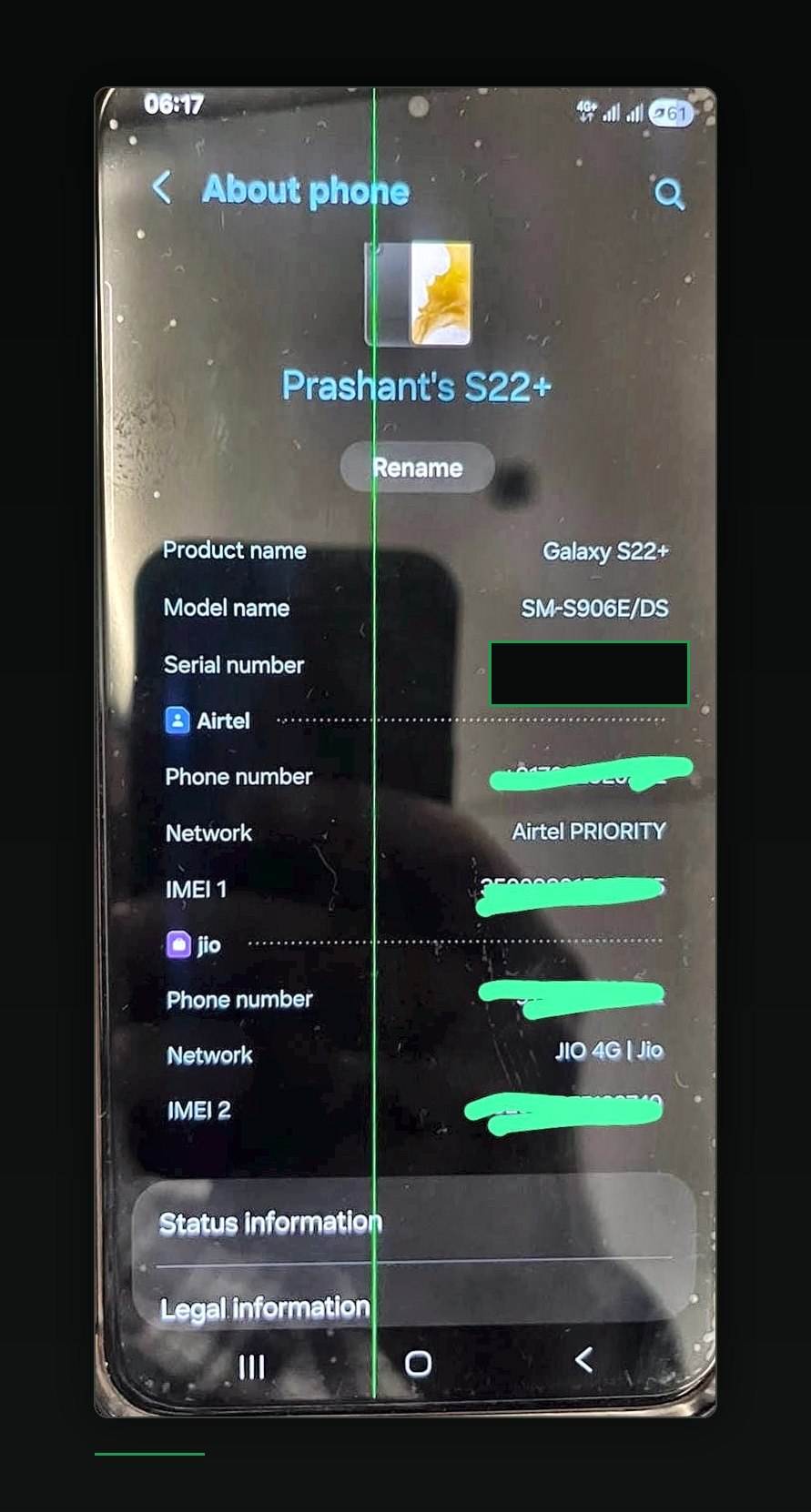
This belongs at the outset: the green line is not exclusive to Samsung. It has been documented on iPhones from the iPhone X onward and on devices from OnePlus, Xiaomi, Vivo and Motorola. It is a known hazard of OLED technology across the industry, and no manufacturer, Samsung included, publishes model-level failure-rate data. Nothing in this article establishes that Samsung phones fail more often than any other brand. What it examines is what Samsung's published terms provide when the failure occurs.
The patternA failure that arrives without warning
The failure has no single trigger, and that is part of what makes it so hard for owners to accept. On Samsung's own community boards and across repair forums, a substantial number of owners report the line appearing within hours of installing a One UI update, on a screen that had no prior damage. Some have coined a phrase for it: a software-induced hardware defect. One consumer commission complaint on record describes exactly that sequence, a prompted restart for a software update followed by a green line on the screen.
Two honest qualifications belong here, because the argument is stronger without overreach. First, an over-the-air update cannot physically break a flex cable, and Samsung has never accepted any causal link. Second, the pattern is not universal: my own S22+ developed the line with no update involved, simply on its own. What the reports establish is not that software breaks the panel, but that the panel fails unpredictably, sometimes under the ordinary stress of a system update, on hardware that gave no prior warning.
Reports of the failure span multiple generations of Galaxy devices, from the S21 and S22 Ultra through the S23, S24 Ultra and S25, and across the Note, Z Flip, A-series and M-series lines.
That establishes breadth of reporting, not prevalence. No manufacturer publishes failure rates, and nothing here quantifies how many devices are affected.
The termsThe three-year cutoff
Samsung did acknowledge the problem and launched a one-time free screen replacement programme, which deserves acknowledgment. The conditions attached to it are where the difficulty lies.
- India only. Owners in the rest of the world get nothing beyond standard warranty.
- Original purchase invoice required, or the claim can be refused.
- No physical or liquid damage, a clause that gives service centers wide latitude to say no.
- A three-year window, measured in several markets from network activation, not from the day you bought it.
- Rolling deadlines: September 2024, then December 2024, then September 2025, with the full model list never published.
The tiering does not stop at the border. Owners of cheaper Galaxy models report being told at Indian service centres that the replacement applies to premium S-series phones but not to the M-series or A-series, leaving them to pay roughly ten thousand rupees for the same failure. Owners also report claims refused at the counter and granted only after escalation. Those past the three-year mark are excluded outright.
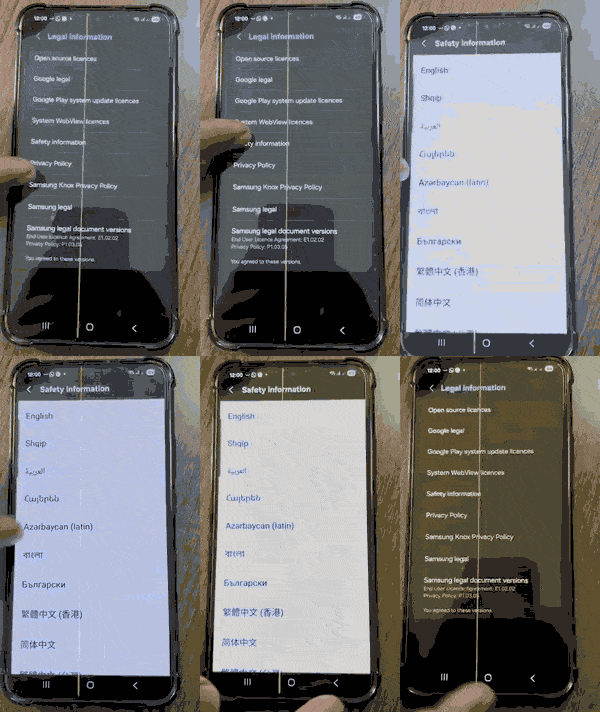
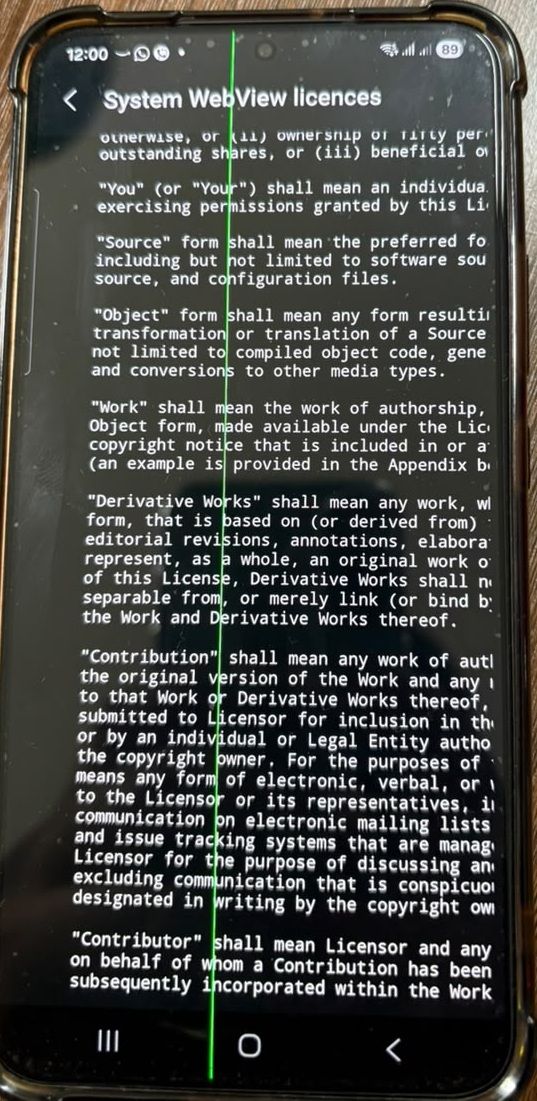
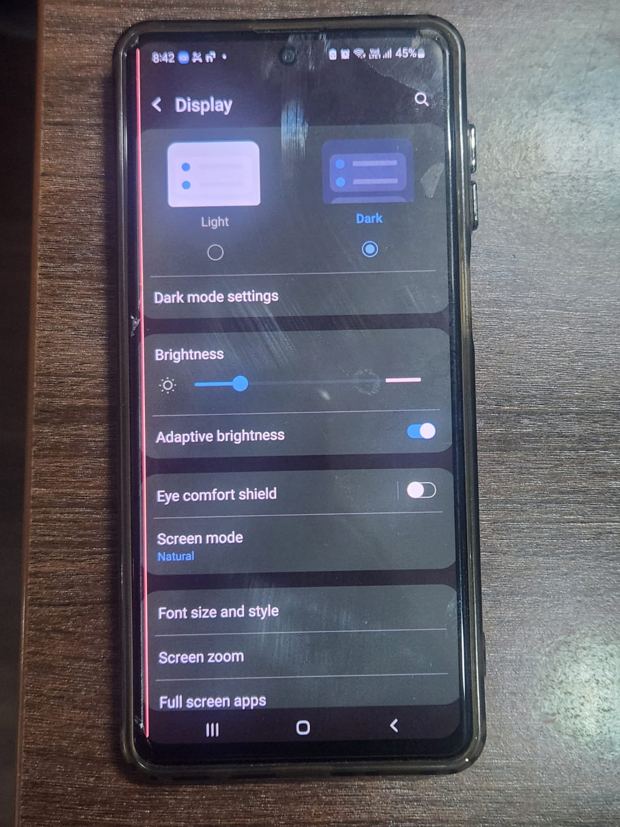
What follows is one case, documented at every step, because a general question about after-sales terms is only answerable against a specific set of facts. I own the Galaxy S22+ in these photographs, bought new directly from Samsung India for 70,299 rupees. In 2026 a bright green line appeared down the centre of the screen on its own, with no drop, no crack and no water. No restart or reset removes it.
On 14 July 2026 I handed the phone to a Samsung authorized service centre. Samsung's own service record describes the fault, in its own words, as "LINES ON DISPLAY," and in the same document stamps the device "Out of Warranty." I asked for a free replacement on the ground that the failure was inherent to the device rather than damage I had caused.
After fifteen days and repeated follow-ups the answer was still no, and Samsung put its position in writing. Its email states that it reviewed the device and found the defect occurred due to display failure. It alleges no drop, crack, liquid or misuse of any kind. The sole stated ground for refusing a free repair is that the unit is out of warranty. It quoted 16,255 rupees, with a 90-day warranty on the replaced part, meaning that if the same failure recurs on day 91 the owner pays again.
To be precise about what Samsung did and did not say: it did not use the words manufacturing defect, and I am not claiming it did. It attributed the failure to the display, and attributed nothing to me. I had the phone repaired outside Samsung's network for roughly half the quoted price, and kept the original panel.
A further escalation to Samsung's CEO office, its highest internal channel in India, confirmed the refusal on the same single ground and again alleged no fault on my part, adding that a free repair would have been provided had it been possible. Samsung sets the warranty term it cites, and has replaced green-line panels at no charge for other owners under its India programme; on the evidence available to me, the constraint described is one Samsung sets rather than an external one. The email instructs me not to reply.
Four touchpoints, one designated by Samsung as its highest level of escalation, and the answer did not change. At no stage did any Samsung document dispute that the panel had failed, and none alleged that I had caused it.
The mismatchTwo clocks running on the same device
From the Galaxy S24 onward, Samsung committed to seven years of operating system and security updates on its premium phones, a genuine and widely praised commitment. Precision matters here, and it cuts against Samsung rather than for it. That seven-year term applies to the S24 and later; my S22+ was sold with four years of operating system upgrades. The standard hardware warranty on both, and on Samsung's flagships generally, is twelve months.
That is the asymmetry at the centre of this article. Software support is promised in years. Cover for the hardware that runs it is measured in months.
That asymmetry is not confined to a 2022 handset. It applies, in the same terms, to the phones Samsung is selling now, and the two charts below set out how each side of it has moved.
Launch prices, base configuration, from Samsung India launch announcements and contemporaneous reporting. The S24 Plus is omitted because I could not verify its India launch price to the same standard. The warranty figure is Samsung's published standard handset warranty, unchanged across the period.
Software commitment against hardware liability, in months. The S22 was sold with four years of operating system upgrades; the S24 and S26 carry the seven-year commitment. The standard manufacturer warranty against manufacturing defects is twelve months in all three cases.
Read the row that does not move. Price has roughly doubled at the base and nearly tripled at the top. The software promise has gone from four years to seven. The warranty against manufacturing defects has not changed by a day. A second year is purchasable: under Samsung Care Plus the extended warranty begins the day after the manufacturer’s warranty expires, so cover for that thirteenth month is available to buy rather than included.
And Samsung cannot argue that a longer warranty on a critical component is impractical, because Samsung already does it. Its own published warranty schedule sets out exactly how long the company is prepared to stand behind particular parts, and the range is striking.
From Samsung's published product warranty schedule, as listed on its Canadian support site in June 2026. Parts cover against manufacturing defects. Refrigerator, washing machine and microwave figures are the extended parts warranties Samsung applies to the inverter compressor, the inverter motor and the magnetron respectively, over and above the twelve-month parts and labour cover on the appliance itself.
Before going further, Samsung's case deserves to be put at its strongest, because it is a serious one. Every warranty needs a defined duration; open-ended cover on consumer electronics is not commercially available from anyone. This device was outside its warranty term when the fault appeared. Goodwill programmes, by their nature, require eligibility boundaries, or they cease to be goodwill and become an uncosted liability. And a manufacturer cannot underwrite hardware indefinitely against failures it has not caused. Every one of those propositions is defensible, and none of them is answered by pointing out that a customer is unhappy.
Two further qualifications, stated before anyone else states them. The ten-year term on a refrigerator compressor is a component warranty, not a whole-appliance one: the refrigerator itself carries twelve months of parts and labour, exactly like a phone. Smartphones are also different products, carried and charged daily rather than standing still in a kitchen. And I am not arguing that a smartphone should carry a ten-year warranty.
So let me state plainly what this comparison is not. It is not an argument that a phone screen should carry a ten-year warranty because a refrigerator compressor does. Those are different products with different duty cycles, and anyone advancing that argument deserves to lose it.
The point is narrower and it is about policy architecture. Samsung's own schedule demonstrates that component-specific extended cover is a tool the company already uses, deliberately, where a particular component is central to how long the product remains usable: the inverter compressor at ten years, the inverter motor at ten, the magnetron at five. Those are expensive parts with real failure exposure, and Samsung has chosen to carry that exposure rather than pass it to the owner. In a premium smartphone the component that determines whether the device remains usable is the display, and it is also the most expensive to replace. The published schedule does not apply component-specific treatment to it.
That is not evidence of wrongdoing, and I do not present it as such. It is the basis for a legitimate strategic question. If premium phones are now marketed for long ownership, with seven years of software support and durability as selling points, is an unchanged twelve-month term the right accountability model for the one component whose failure ends the device's useful life?
A second objection is that every manufacturer offers twelve months, and that is correct. Apple, Google and the rest are on the same term, so this is not a case of Samsung trailing its rivals on warranty length. But Samsung's own conduct complicates that defence. It has operated an out-of-warranty display replacement programme covering qualifying devices up to three years, which it designed, gave published deadlines, extended more than once, and under which it supplied panels at no charge on phones well outside the warranty term. That programme is not a warranty and I am not calling it one; a warranty is a contractual commitment, while this is discretionary and revocable. Its significance lies in its existence, its scope and its limits.
That programme is the most telling document here, and my reading of it is this. Samsung has not published its reasoning and I do not claim to know it. But a three-year replacement scheme, extended more than once, supplying free panels on out-of-warranty phones, is at least consistent with an internal view that the standard twelve-month term does not fit this particular failure. The difference between that programme and a warranty term is not its length. It is that one is discretionary, confined to one market, unpublished as to models and subject to expiry, while the other would be an obligation an owner could rely on.
I want to be careful about what I am and am not claiming here, because the distinction matters. I have no failure-rate data for any Samsung model, and I am not asserting that these phones are unreliable in some measurable sense. Samsung does not publish that data and neither does anyone else. What is documented, precisely and from Samsung's own terms, is the asymmetry. Eighty-four months of promises about the future, twelve months of liability for the present, on a device priced at nearly two lakh rupees. Whatever the true failure rate turns out to be, the person carrying that risk from month thirteen onward is the customer.
Longevity you can advertise is measured in years. Longevity you must honor is measured in months.
The present tenseWhat 1.4 lakh rupees buys in 2026
None of this is history. Samsung launched the Galaxy S26 series in India on 25 February 2026. The S26 Plus opened at 1,19,999 rupees for the 256GB configuration and 1,39,999 for the 512GB. The S26 Ultra opened at 1,39,999, rising to 1,59,999 and then 1,89,999 rupees for the terabyte model. In the United States the S26 Plus went up a hundred dollars over its predecessor while the Ultra held its price. These are, by any measure, luxury-goods numbers.
So it is worth asking the simple question. On a phone that can cost 1,89,999 rupees, what does Samsung actually guarantee?
Read the last two rows together. In April 2026, promoting Care Plus for the S26 series, Samsung's newsroom cited research that the average phone upgrade cycle has lengthened from 2.4 years to 3.5 years globally, describing it as a shift toward longer device ownership. The figure is one Samsung cites rather than one it generated, but the company evidently regards it as sound, and it is presumably part of why seven years of updates is marketed at all.
Now hold that number against the terms above. Free hardware cover runs twelve months. The most a customer can buy runs to two years. The goodwill scheme for this display failure closes at three years, in one market, against the original invoice. On the figure Samsung itself promotes, the typical owner is still using the phone for roughly two and a half years after the last free protection has lapsed. Every one of those hardware commitments sits below the ownership period Samsung publicises.
One further number belongs alongside those terms. On resale Samsung is the strongest Android brand: used-market trackers put first-year retention for an iPhone flagship at roughly two-thirds of purchase price and a Galaxy S flagship closer to half, with other Android brands lower again. I give those as approximate ranges rather than a chart, because they are composites of commercial trackers rather than a single audited dataset.
This is where the phrase premium quality needs separating into its two halves, because they are not the same claim and Samsung performs very differently on each. On engineering, Samsung is excellent and I would not argue otherwise. The panels, cameras and silicon in an S26 Ultra are among the best made by anyone, and the green line is a failure mode that afflicts OLED displays across the industry, Apple's included. The problem is not that Samsung builds poor hardware.
The problem is the reliability commitment, which is a different thing entirely. Reliability is not only how rarely a component fails. It is what happens to you when it does. Measured that way, a Samsung flagship is a premium product carrying an ordinary guarantee: luxury pricing, seven years of software, twelve months of hardware, and a documented pattern of the company declining to help beyond the letter of that rule even when its own paperwork says the customer did nothing wrong. That is not a quality defect. It is a confidence defect, and Samsung is the only party who can repair it.
The benchmarkWhat accountability would look like
There is an established template for handling this kind of problem, and it is worth setting out precisely rather than approximately. Apple has twice published a display programme of its own. Its iPhone X Display Module Replacement Program covered affected devices for three years after first retail sale. Its iPhone 11 Display Module Replacement Program, addressing displays that stopped responding to touch on units manufactured between November 2019 and May 2020, covered eligible devices for two years after first retail sale and used a serial-number checker to determine eligibility. Both programmes provided the repair at no charge to qualifying devices, and both told customers who had already paid for the repair that they could approach Apple about reimbursement.
The comparison has limits and I should mark them. Apple has never run a green-line programme; iPhone owners reporting that failure have generally been directed to AppleCare or to a paid repair. Apple's programmes were also bounded, by manufacturing date, by serial number, and by a two or three-year window. So this is not a case of one company behaving well and another badly on display defects generally.
What the comparison does establish is narrower. When a manufacturer decides to stand behind a display component beyond the warranty term, there is a recognised way to do it: publish the affected models, publish the eligibility window, provide the repair at no charge to devices that qualify, and reimburse customers who paid before the programme existed. Samsung's green-line programme differs on the first of those points in particular. Its eligible-model list has not been published, its terms require the original invoice, and its coverage has been confined to India with deadlines that have moved more than once.
Right of replySamsung's position, in Samsung's words
Something should be said plainly. Samsung was responsive. Every message was answered, the service centre logged the fault accurately rather than fudging it, Samsung escalated the case internally without being asked, the CEO’s office replied, and nobody suggested I had damaged the phone. On responsiveness alone this was handled better than many companies manage.
That is what makes the outcome worth examining. Had Samsung ignored me, this would be a story about poor service, and every large company generates those. Instead the process ran as designed and produced this result: a device with no alleged damage and a documented display failure, repaired at the owner’s cost. The criticism here is therefore not directed at the technician in Whitefield or the agents who replied to my emails, who applied the terms they were given. It is directed at the terms.
Samsung has stated its case repeatedly and in writing. It is reproduced here as faithfully as I can put it, because it is central to the story and because readers are entitled to weigh it themselves.
There is one question I would put to Samsung, and it is deliberately answerable. If an authorised service centre identifies an internal display failure and records no impact, liquid damage or misuse, what principle determines whether the manufacturer bears the repair cost beyond the standard warranty term, and why should that principle turn primarily on an eligibility date rather than on the nature of the failure? Samsung has not addressed that question in any of its correspondence with me. If it responds, its answer will be published here in full.
The device was reviewed and the reported defect was found to have occurred due to display failure. As the unit is out of warranty, the repair cannot be covered free of charge. Support is available on a chargeable basis, estimated at 16,255 rupees, with a 90-day warranty on the replaced part. Had it been possible, a free-of-cost repair would have been provided.
That is a fair summary of three separate communications: the authorized service centre, Samsung Customer Support, and the office of the chief executive in India. Samsung declined to comment further, and the final email instructed me not to reply to it.
That position deserves examination rather than dismissal. Samsung is not saying the customer broke the phone, and it is not disputing that the panel failed. It is making a narrow contractual argument: the warranty period ended, so the obligation ended. The difficulty is that Indian consumer law does not stop where a warranty stops. A limited warranty is a contractual promise; liability for a defective product is statutory. That is why commissions have ruled against Samsung in out-of-warranty display matters, and why the Kolkata commission set out later in this article placed the burden of proving mishandling on the manufacturer rather than on the customer. In my case that proof was never attempted, because the allegation was never made.
And the phrase that lingers is the last one. Had it been possible. Nothing made it impossible. Samsung set the warranty term. Samsung set the three-year window on its own goodwill scheme. Samsung has replaced these panels free of charge for other owners, in India, under a programme it designed and publicised. Samsung has performed this repair at no charge for other owners under a programme of its own design. Whether to extend it further is, on the face of the published terms, a decision within Samsung’s control. That question is the subject of this article.
The bigger pictureThree separate matters, one recurring question
What follows draws together three separate matters: the green line, the 2022 Game Optimizing Service controversy, and reported foldable-screen failures. They are distinct problems with distinct causes, and evidence about one does not establish anything about another. I group them here because, in my view, they raise the same question about what happens after the sale. That connection is my argument, not a finding.
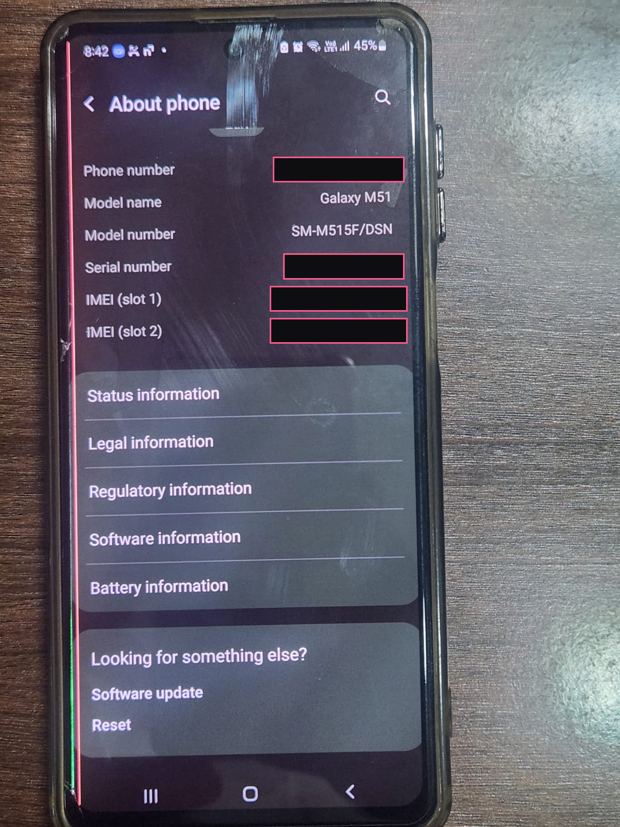
Owner reports span the S20, S21, S22, S23, S24 Ultra and S25, the Note 20, the Z Flip, and mid-range models including the A73, the M51 and the M52. Two of those mid-range accounts appear in this article and they are separate owners: a Galaxy M52 owner posting on Samsung's community forum, who reported being told no spare panel was available even though they offered to pay; and a Galaxy M51 belonging to an acquaintance of mine, photographed for Exhibits C and D below. A repair specialist quoted by Forbes said he had yet to see any manufacturer resolve a fault of this kind with a software patch. Another owner described two separate S21 handsets failing at roughly 1,300 days each: a single account rather than a study, but one that recurs in form across those boards.
It is not even always green. Owners report the same failure presenting in pink and in white, on the same panels, arriving the same way. The phone in Exhibits C and D belongs to an acquaintance of mine. It is a Galaxy M51 (SM-M515F), a mid-range model rather than a flagship, and a different device and owner from the M52 account introduced above. Its line is pink, it runs down the left edge, and it appeared the same way: on its own, with no damage. Unlike the rest of the evidence in this article, this one rests on my own photographs and the owner's account rather than on service documentation.
These boards contain no usable failure data, but they do contain a great deal of disappointment, written by people trying to work out what to do next. Four accounts, paraphrased.
One owner, unconnected to this article's other cases, is on their second Samsung with the same failure, first a Z Flip 3 and then an M52. The service centre had no panel to sell them, even though they offered to pay for it. They now advise other people to keep off Samsung, and describe the service in one unprintable word.
Another bought two S21 handsets in 2021. The first developed the line in late 2024, so he replaced it with an S25. Then the second failed the same way, and he worked out that both had lasted roughly 1,300 days, as though the screen carried a shelf life nobody had mentioned at the point of sale.
A third was told his phone had passed three years and was no longer entitled to a replacement. He says he still loves his S23 Ultra. He simply cannot face paying for the same failure twice.
And on a thread about an S22, an owner reported theirs had gone the same morning, then asked the question that sits underneath all of this: what else can we do.
None of these are people who dislike Samsung. Several say plainly that they liked the phone and bought Samsung again. They paid a premium partly for an expectation about what would happen if something went wrong, and are reporting what happened instead.
In 2022 Samsung's Game Optimizing Service was found to throttle the performance of around 10,000 applications while leaving benchmark apps unaffected. Geekbench described this as manipulation and delisted four generations of Galaxy S flagships, the S10 through the S22. Samsung's chief executive apologised publicly, and a Korean court later required compensation for S22 owners who sued over the feature.
Separately, owners of the Galaxy Z Flip and Z Fold report inner screens cracking along the crease and panels going dark, in some accounts within a year and without any drop. A United States class action alleges the Z Fold 3 does not meet its advertised durability, and a consumer law firm has run a pre-litigation investigation into the blackout and dead-pixel reports.
Each episode has the same three beats. A premium promise, a shortfall Samsung did not volunteer, and a resolution process that puts the burden back on the buyer. On the author's analysis, the pattern is not the defect itself but the shape of the response to it.
The recordWhat is actually on the record
These disputes have not stayed at the service counter. In four jurisdictions there are filed or decided proceedings; in several others, owners report lodging individual complaints. The matters below concern three distinct product problems, and I have set out what each one actually is. Grouping them is my argument about after-sales accountability, not evidence that any one proves another. Status as of July 2026.
Two findings from the Indian record deserve to be read closely, because they cut directly against the position Samsung takes at the service counter. In a green-line complaint decided at Kottayam in Kerala, the judgment records that when the owner of a Galaxy S21 FE complained, Samsung told him a green line had appeared on all Samsung S21 and S22 model phones. That is Samsung, in a court record, describing the defect as universal across two flagship generations, not as one unlucky handset.
The second is Sk Nazrul Islam v. Samsung India Electronics, decided by the Kolkata District Consumer Commission on 3 July 2026, and it matters for how the Commission reasoned. A Galaxy Z Flip 3 bought for 85,000 rupees developed a black shadow near the fold inside the one-year warranty. Samsung's service centre quoted 29,849 rupees, calling the damage accidental and liquid related, and argued that a crack on the side of the body evidenced external impact.
The Commission rejected that defence using Samsung's own repair estimate, which listed the internal OCTA display panel rather than the outer cover glass a drop typically damages. It observed that the company had not explained why an external impact to the body would require replacing the internal display as the primary repair item, held that Samsung had failed to discharge its burden of proving mishandling, noted the pattern documented in the US class action Lewis v. Samsung Electronics America, and ordered replacement or refund with compensation and costs. That is a foldable-hinge matter rather than a green-line one, but the allocation of the burden is the point: it rests with the manufacturer. In my own file, no Samsung document alleges impact, liquid or misuse at all.
Status as of July 2026. These are three distinct product problems and evidence about one does not establish anything about another; they are set out together because, in my argument, they raise the same after-sales question. Each entry is labelled by what it actually is: a filed class action, a decided complaint, a court-ordered mediation, a law-firm investigation, or an owner report. Case details are drawn from legal-news reporting and public case databases and should be confirmed against primary records before republication.
The map tells the story. A defect Samsung will repair for free in one country, it will litigate against in another. The phone is identical. The panel is identical. Only the accountability changes at the border.
The economicsThe arithmetic of saying no
Set the grievance aside and look at the commercial arithmetic. On 14 July there were two available courses: replace the panel as goodwill on a phone Samsung had sold directly, at the cost of part and labour; or apply the warranty rule. The second was applied, and this is the ledger that followed.
Samsung collected nothing. The repair happened anyway, at half the price and by someone else, so the value went to an independent technician in Bengaluru. Scale that once: a flagship buyer replacing a phone every three years represents a fifteen-year, five-device relationship, four to five lakh rupees at Indian flagship prices before tablets, watches, televisions and recommendations to others. That is illustrative arithmetic rather than Samsung's internal model, but on a single customer no plausible version of it favours the refusal.
Which is why calling this pettiness is too generous. A trade like that is not made one customer at a time; it only makes sense in aggregate. If this failure affects even a modest percentage of a very large installed base, an open-ended replacement commitment becomes a contingent liability of real consequence, the kind that must be disclosed and provisioned. A three-year window, in one country, with an invoice requirement, a damage exclusion, an unpublished model list and rolling deadlines reads, on my interpretation, as a boundary on that exposure, drafted with some specificity rather than left vague.
Limiting exposure is a legitimate thing for a finance function to want, and I am not suggesting otherwise. My argument is about what such a calculation tends to leave out. Warranty exposure is measurable. Brand equity is not. Inside large organisations the measurable number usually prevails, and it is frequently the wrong one. I cannot see Samsung’s internal analysis and I am not claiming to know what it contains.
What is being protected is not only a repair budget. Samsung's premium positioning rests on the claim that a Galaxy flagship is worth iPhone money, and that claim is built on assertions about the future: hardware quality, long support, durability. Assertions about the future are trust claims, and they are tested at the service counter rather than in the launch keynote. I cannot say what this has cost Samsung in market share, having no churn or brand-tracking data and no intention of inventing any. What the owner posts quoted earlier show is people publicly advising others against the brand.
The remedyWhat would actually close the gap
A manufacturer selling longevity at premium prices has to underwrite it on the hardware as well as the software. Four steps would close the gap in Samsung's case, and the same four would apply to any brand in the same position.
- Make it global and permanent. A defect programme should cover every market where the affected models were sold, rather than one country on a deadline that moves.
- Publish the terms. Release the complete list of eligible models and the exact conditions, and stop leaving customers to litigate their own claims at a service counter.
- Match cover to the advertised life. If a phone is marketed with years of software support, the component that determines whether it still works deserves more than twelve months of warranty and a conditional goodwill window.
- Stand behind the repair. A 90-day warranty on a replaced panel is not adequate for a known, recurring failure mode. Owners who pay for this repair should not be exposed to paying for it again.
One fact sits underneath all of this and is not in dispute. Samsung has replaced these panels at no charge, for real owners, on phones out of warranty, under a programme it designed and extended more than once. The diagnosis, the parts, the service network and the approving authority all exist inside the company, and the precedent was set by Samsung itself. What separates those owners from me is not capability. It is the scope of the terms.
Which returns this to the question it began with, and that question is not really about one company. Something has changed in what manufacturers ask buyers to believe about a phone. For most of the smartphone era it was a two-year purchase, replaced on contract, and a twelve-month warranty sat reasonably against that expectation. Seven years of promised software support describes a different product: a long-lived computing platform, sold on the premise that it is worth keeping. Samsung has made that case more prominently than most, and on the software side it has delivered.
The part that has not visibly moved with it is the hardware accountability model. Warranty term, service policy and defect-programme scope look much as they did when phones were replaced every two years, even as designed lifespan, marketed lifespan and price have all risen. That gap is not a service-desk problem. In a premium product it runs through the whole proposition: what the keynote promises, how long the device is designed to last, how long the software is supported, how long the hardware is covered, what happens at the service counter, whether the brand retains trust, what the device is worth secondhand, and what price the next one can command. The keynote sets the expectation. The service counter is where it is tested.
Which yields a test any buyer can apply to any brand before spending the money. Ask how long the software support runs. Then ask how long the manufacturer stands behind the component whose failure ends the device's useful life. Where those two numbers are years apart, the difference between them is not underwritten by the seller. It sits with the owner, unpriced and usually unmentioned.
If longevity is part of the sale, accountability for longevity has to be part of the product.
Open fileHave you experienced a similar display failure?
This investigation rests on one thoroughly documented case, published warranty terms and the proceedings on record. What it cannot establish is prevalence, because no manufacturer publishes failure rates and a collection of individual accounts is not a dataset. That gap can be narrowed, but only with documents.
If a display on your device has failed without impact or liquid damage, and you are willing to share what you have, the following is what makes a submission useful rather than merely anecdotal: device model and storage variant; country of purchase; purchase date and price; the date the failure appeared; photographs or video of the screen; the service centre's written diagnosis or job sheet; any written response from the manufacturer; whether free replacement was approved or declined, and the reason given; and the repair cost quoted.
Documented submissions will be treated as evidence. Undocumented ones are still welcome and still useful as context, but they will be described as owner reports and will not be presented as establishing how often this failure occurs. Nothing identifying a contributor will be published without explicit permission, and reference numbers, serial numbers, IMEI numbers and contact details should be redacted before sending. Where a verified body of cases accumulates, it will be published as an update to this article with its methodology stated.
Sources and documents
Every factual claim in this article traces to one of the following: a document in the author's possession, a consumer-commission or court record, or published reporting. Case details are summarised from legal-news reporting and public case databases rather than from certified copies, and readers are encouraged to consult the primary judgments directly.
Primary documents held by the author
- Samsung India Electronics Pvt. Ltd. tax invoice no. 29S1I0080079 dated 17 September 2022, Galaxy S22+ (SM-S906E), total value 70,299.05 rupees, purchased directly from Samsung.
- Samsung authorized service centre acknowledgement of service request, bill no. 4438944270 dated 14 July 2026, recording defect description "LINES ON DISPLAY" and warranty status "Out of Warranty."
- Samsung Customer Support email confirming the defect occurred due to display failure, declining free repair on the ground that the unit is out of warranty, quoting 16,255 rupees for repair with a 90-day warranty on the replaced part.
- Samsung escalation email dated 20 July 2026 confirming referral to its "Highest-Level Escalation team" under reference number 3101279196.
- Samsung CEO office reply confirming the refusal on the same ground and instructing the author not to reply.
- Photographs and video of the affected Galaxy S22+ showing the green line fixed in position over scrolling content; photographs of a second affected device.
- The original defective display panel, retained by the author and available for expert inspection; third-party repair invoice evidencing the cost actually incurred.
Indian consumer commission records
- Alex Eapen v. Samsung Head Office, District Consumer Disputes Redressal Commission, Kottayam, C.C. No. 175/2024, filed 20 May 2024, judgment dated 28 January 2025. Bench: Manulal V.S. (President), Bindhu R. and K.M. Anto (Members). Galaxy S21 FE purchased 20 July 2022; green line appeared about nineteen months later. The judgment records Samsung stating that a green line had appeared on all Samsung S21 and S22 model phones. Via CaseMine.
- Sk Nazrul Islam v. Samsung India Electronics Pvt Ltd, Kolkata District Consumer Commission, judgment delivered 3 July 2026. Bench: Kollol Chattopadhyay (President) and Udayan Roy (Member). Galaxy Z Flip 3 5G purchased 29 January 2022 for 85,000 rupees; black shadow appeared near the fold on 15 November 2022, within warranty; service centre demanded 29,849 rupees terming the damage accidental and liquid related. The Commission relied on Samsung's own repair estimate, which listed the internal OCTA display panel rather than the outer cover glass, held that Samsung had failed to discharge its burden of proving mishandling, and ordered replacement or refund of 85,000 rupees with 25,000 compensation and 10,000 costs. The complainant relied on the US class action Lewis v. Samsung Electronics America, Inc. and an investigation by Migliaccio and Rathod LLP. Reported by Bar & Bench, 17 July 2026, which also published the full order.
- Doneshwar Arya v. Samsung India Electronics, District Consumer Disputes Redressal Commission, North District, Delhi, Consumer Complaint No. 282/2024. Bench: Divya Jyoti Jaipuriar (President), Ashwani Mehta and Harpreet Kaur (Members). Galaxy A35 developed a line on the LCD display within days of purchase; Samsung held liable for deficiency in service and unfair trade practice, refund and compensation ordered. Reported by 24law.
- Amrit Pal Singh v. Reliance Retail Ltd. and Samsung India Electronics Pvt. Ltd., District Consumer Disputes Redressal Commission-II, Chandigarh. Bench: Amrinder Singh Sidhu (President) and B.M. Sharma (Member). Samsung held liable for deficiency in service and unfair trade practice over a defective LED television; refund of 79,980 rupees with 9 percent interest plus 10,000 in compensation and costs. Reported by LiveLaw.
- Further green-line complaints on record before District Consumer Commissions, including Naveen A. Varkey v. Samsung Electronics Co. Ltd. (green line appeared 26 December 2023 and progressively worsened) and Jerin George v. Samsung India Electronics Pvt. Ltd. (green line appeared after a prompted restart for a software update in April 2024). Via CaseMine. Outcomes should be confirmed from the judgments.
International litigation and regulatory action
- Thailand: the Thailand Consumers Council and 119 consumers filed a class action against Samsung in Bangkok's Southern Civil Court over vertical green and pink lines appearing on Galaxy models after a firmware update, after Samsung's Thai division declined compensation. Sophon Nurat, a TCC division head, confirmed the filing. Reported by the Bangkok Post, August 2024.
- South Korea: class action by 1,882 consumers over the Game Optimizing Service, which throttled application performance. The Seoul Central District Court dismissed the claims at first instance while describing the advertising as misleading; on appeal the Seoul High Court issued a forced mediation requiring Samsung to compensate the plaintiffs.
- United States: class action filed in the US District Court for the District of New Jersey on 11 March 2022 alleging fraud and unjust enrichment over hidden performance throttling on the Galaxy S22 and other models.
- United States: class action in New York federal court alleging the Galaxy Z Fold 3 fails to meet its advertised durability of 200,000 folds, approximately five years of use.
- United States: law-firm investigations into Galaxy Z Flip and Z Fold inner-screen cracking, blackouts and dead pixels on devices that were not dropped. Migliaccio & Rathod LLP.
- Other jurisdictions: owner accounts, published on Samsung community boards and in consumer forums, of individual complaints lodged with the Department of Trade and Industry in the Philippines, with consumer authorities in Malaysia, and through EU dispute-resolution channels. These are owner reports of individual complaints rather than verified regulatory proceedings, and are labelled as such in the text.
Technical and press reporting
- Forbes, Jay McGregor, on the Galaxy green line display problem, quoting Ricky Panesar of iCorrect that he had yet to see any manufacturer resolve a green-line fault of this kind with a software patch, and noting Samsung's earlier free screen replacements for Galaxy S20 and Note 20 green and pink lines in July 2023.
- Geekbench delisted Galaxy S10, S20, S21 and S22 series devices in 2022 after Samsung's Game Optimizing Service was found to throttle roughly 10,000 applications while sparing benchmark apps; Samsung's chief executive issued a public apology.
- Samsung Members community threads, from which the owner accounts in this article are paraphrased, documenting green-line failures across Galaxy S20, S21, S22, S23, S24 Ultra, S25, Note 20, Z Flip, A73 and M52 devices, including owners told they had exceeded three years and were no longer entitled to replacement, and reports of unavailable spare panels.
- Samsung India's free green-line screen replacement programme terms as reported, including the requirement of an original invoice, exclusion of physical and liquid damage, and successive deadline extensions.
- Apple's published display module replacement programmes. The iPhone X Display Module Replacement Program covered affected devices for three years after first retail sale. The iPhone 11 Display Module Replacement Program, covering displays that stopped responding to touch on units manufactured between November 2019 and May 2020, covered eligible devices for two years after first retail sale and used a serial-number eligibility checker. Both provided service at no charge to qualifying devices and directed customers who had already paid for the repair to contact Apple about reimbursement. Apple support documentation and contemporaneous reporting, December 2020.
- Used-market depreciation data for 2025 to 2026 from SellCell, Swappa and ecoatm on first-year resale retention for iPhone, Galaxy S and other Android flagships.
- Galaxy S Plus India launch prices used in Figure 1: S22 Plus 84,999 rupees (2022), S23 Plus 94,999 rupees (2023), S25 Plus 99,999 rupees (2025), S26 Plus 1,19,999 rupees (2026), base configurations. Samsung India launch pricing as reported by GSMArena, MySmartPrice, Cashify and Smartprix. The S24 Plus is omitted for want of an equivalently verified figure.
- Galaxy S26 series launch and pricing: announced 25 February 2026, released 11 March 2026. India launch prices for the S26 Plus of 1,19,999 rupees (256GB) and 1,39,999 rupees (512GB), and for the S26 Ultra of 1,39,999, 1,59,999 and 1,89,999 rupees, with a limited Samsung Days discount that ended 6 July 2026. United States launch pricing of 899.99, 1,099.99 and 1,299.99 dollars for the S26, S26 Plus and S26 Ultra. Seven-year operating system and security update commitment. Smartprix, GSMArena, Bajaj Finserv and 91mobiles listings, 2026.
- Samsung's published product warranty schedule, Samsung Canada support site, page dated 16 June 2026: Mobile Phones and Tablets, twelve months, covering the Galaxy Z, S, A and XCover series; memory cards ten years; USB flash drives five years; SSDs thirty-six months; business monitors, professional displays and direct LED modules thirty-six months; The Terrace outdoor television and The Premiere projector twenty-four months. Extended parts cover of ten years on refrigerator digital inverter compressors and washing machine digital inverter motors, and five years on microwave magnetrons, over and above twelve months parts and labour on the appliance. The same page states that Samsung limits service for smartphones, tablets and wearables to the country of first sale, and that a one-year limited warranty applies regardless of the warranty period in the country of first sale. samsung.com/ca/support/warranty
- Samsung warranty terms: Samsung India provides a twelve-month standard warranty on handsets against manufacturing defects, with proof of purchase a prerequisite for any claim. Samsung Care Plus offers a second year of warranty commencing the day after the manufacturer's warranty expires. Samsung India support and warranty pages; Samsung Care Plus and Servify plan terms for India.
- Samsung India Care+ terms, page last updated 21 May 2026: extended warranty of one year, screen-only protection of one year, accidental and liquid damage protection of one year, and comprehensive protection combining accidental damage and warranty for two years, all sold in addition to the standard manufacturer warranty. Consumer Reports, March 2026, describes Samsung Care+ as extending the manufacturer's one-year warranty.
- Samsung newsroom, April 2026, promoting Samsung Care Plus for the Galaxy S26 series, citing research that the average phone upgrade cycle has increased from 2.4 years to 3.5 years globally and describing this as a shift toward longer device ownership. The statistic is attributed by Samsung to a third-party source rather than generated by Samsung.
Based on the author's own Samsung purchase invoice and service records, photographic and video evidence from two affected devices, Forbes and independent repair-industry reporting, owner reports across Galaxy S, Note, Z Flip, A-series and M-series models, Indian consumer commission rulings, the Thailand Consumers Council class action, South Korean court rulings and US filings over the Game Optimizing Service, a US class action and law-firm investigations into Galaxy Z Flip and Z Fold screen failures, regulator complaints in the Philippines and elsewhere, Geekbench's 2022 delisting of Galaxy S flagships, 2025 to 2026 used-market depreciation reports (SellCell, Swappa, ecoatm), Samsung community forums, Samsung India's replacement-program terms, Apple's published display module replacement programs, and independent repair-industry reporting. The green line, the GOS throttling scandal and the foldable failures are three distinct defects. Case details should be verified against primary court records before republication. The criticism here concerns Samsung's support and accountability policy, not a claim of a unique or exclusive defect.